MCQ
Hybridisation involves
  • A
    Addition of an electron pair
  • Mixing up of atomic orbitals
  • C
    Removal of an electron pair
  • D
    Separation of orbitals

Answer

Correct option: B.
Mixing up of atomic orbitals
(b) Merging (mixing) of dissimilar orbitals of different energies to form new orbitals is known as hybridisation and the new orbital formed are known as hybrid oribitals.

They have similar energy.

Need a full question paper?

Generate a complete, print-ready paper with questions like this in minutes — across 16+ boards, with answer keys.

Start Generating Free

Similar questions

$H.O.M.O.$ (Highest Occupied Molecular Orbital) of $CO $ molecular is
In $IIIA$ group, $Tl$ (thalium) shows $+1$ oxidation state while other members show $+3$ oxidation state. Why
The $IUPAC$ name of $\begin{matrix}
   C{{H}_{2}}-CH=CH-CHO  \\
   |\,\,\,\,\,\,\,\,\,\,\,\,\,\,\,\,\,\,\,\,\,\,\,\,\,\,\,\,\,\,\,\,\,\,\,\,\,\,\,\,\,\,\,\,\,\,\,\,\,\,\,\,\,\,\,\,\,\,\,\,\,\,\,\,\,  \\
   CHO\,\,\,\,\,\,\,\,\,\,\,\,\,\,\,\,\,\,\,\,\,\,\,\,\,\,\,\,\,\,\,\,\,\,\,\,\,\,\,\,\,\,\,\,\,\,\,\,\,\,\,\,\,\,\,\,  \\
\end{matrix}$ is
For the identification of $\beta$-naphthol using dye test, it is necesary to use : 
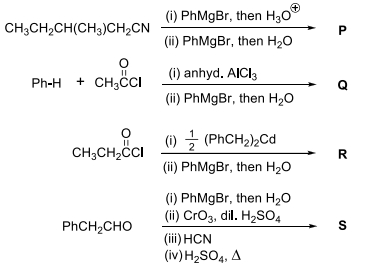
In the following reactions, $P, Q, R$, and $S$ are the major products.

The correct statement($s$) about $P, Q, R$, and $S$ is(are)

($A$) Both $P$ and $Q$ have asymmetric carbon($s$).

($B$) Both $Q$ and $R$ have asymmetric carbon($s$).

($C$) Both $P$ and $R$ have asymmetric carbon($s$).

($D$) $P$ has asymmetric carbon(s), $S$ does not have any asymmetric carbon.
Reagent used for detection of $Ni^{2+}$ is $A. x$ mol of $A$ reacts with $Ni^{2+}$ and give a complex of $C$ colour. $A, x, C$ are respectively
Of the following, which has three electron bond in its structure
A liquid hydrocarbon can be converted to gaseous hydrocarbon by
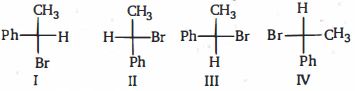
The pair of enantiomers among the following compound is
Given below are the half-cell reactions :

$Mn^{2+} +2e- \rightarrow Mn;\, E^o = -1.18\,V$

$2(Mn^{3+} +e^- \rightarrow Mn^{2+} )\,;\,E^o=+1.51\,V$

The $E^o$ for $3Mn^{2+} \rightarrow Mn+ 2Mn^{3+}$ will be :