$(i)\, {CCl_3}^-$ $(ii)\,CCl_2$ $(iii)\, (SiH_3)_2O$ $(iv)\, N(SiH_3)_3$
- ✓$(i), (ii)$
- B$(i), (iii)$
- C$(ii), (iii)$
- DAll
$(i)\, {CCl_3}^-$ $(ii)\,CCl_2$ $(iii)\, (SiH_3)_2O$ $(iv)\, N(SiH_3)_3$
So central atom has a lone pair and side atom must have vacant orbital
So : $CCl _3^{-}$
$N \left( SiH _3\right)_3$
$sp ^3- sp ^2$
Generate a complete, print-ready paper with questions like this in minutes — across 16+ boards, with answer keys.

Assertion $(A) :$ A simple distillation can be used to separate a mixture of propanol and propanone.
Reason $(R) :$ Two liquids with a difference of more than $20^{\circ} \mathrm{C}$ in their boiling points can be separated by simple distillations.
In the light of the above statements, choose the most appropriate answer from the options given below:

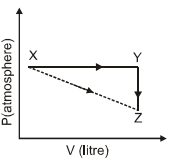
$(A)$ $\Delta S _{ x \rightarrow z}=\Delta S _{ x \rightarrow y}+\Delta S _{ y \rightarrow z}$
$(B)$ $w_{x \rightarrow z}=w_{x \rightarrow y}+w_{y \rightarrow z}$
$(C)$ $w_{x \rightarrow z \rightarrow z}=w_{x \rightarrow y}$
$(D)$ $\Delta S _{x \rightarrow y \rightarrow z}=\Delta S _{x \rightarrow y}$