MCQ
Hydrogen bonding is maximum in
- ✓Ethanol
- BDiethyl ether
- CEthyl chloride
- DTriethyl amine
Hydrogen bonding is observed when $H$ atom is attached to more electronegative $N, F$ or $O$ atom.
Thus, hydrogen bonding is possible in ethanol and triethylamine.
In ethanol, $H$ is attached to a more electronegative oxygen than in
triethylamine, in which $H$ is attached to a less electronegative nitrogen.
Moreover, in triethyl amine, the $+ I$ effect of three methyl groups decreases the extent of hydrogen bonding.
Generate a complete, print-ready paper with questions like this in minutes — across 16+ boards, with answer keys.
$Hb{O_2} + {H_3}{O^ + }C{O_2} \rightleftharpoons \left( {{H^ + } - Hb - C{O_2}} \right) + {O_2} + {H_2}O$
Release of $O_2$ is favoured when there is
The number of possible product for $x$ and $y$ is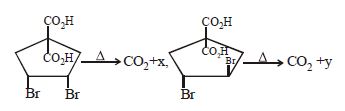
[Given, atomic number: $Mn =25, Fe =26, Co =27$; en $= H _2 NCH _2 CH _2 NH _2$ ]