MCQ
Hydrogen bonding is maximum in
  • Ethanol
  • B
    Diethyl ether
  • C
    Ethyl chloride
  • D
    Triethyl amine

Answer

Correct option: A.
Ethanol
a
Hydrogen bonding is maximum in ethanol.

Hydrogen bonding is observed when $H$ atom is attached to more electronegative $N, F$ or $O$ atom.

Thus, hydrogen bonding is possible in ethanol and triethylamine.

In ethanol, $H$ is attached to a more electronegative oxygen than in

triethylamine, in which $H$ is attached to a less electronegative nitrogen.

Moreover, in triethyl amine, the $+ I$ effect of three methyl groups decreases the extent of hydrogen bonding.

Need a full question paper?

Generate a complete, print-ready paper with questions like this in minutes — across 16+ boards, with answer keys.
Start Generating Free

Similar questions

In acidic medium required number of moles of ferrous oxalate for reduction of $2.5\, moles$ of $KMnO_4$ is
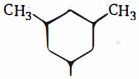
How many geometrical isomers are possible for the above compound ?
For the alkali metals, which of the following increases with increasing atomic number?
Of the four oxyacids of chlorine the strongest oxidising agent in dilute aqueous solution is
Which of the following molecules represents the order of hybridisation $sp^2, sp^2, sp, sp$ from left to right atoms ?
$10\, mL$ of $1\,mM$ surfactant solution forms a monolayer covering $0.24\, cm^2$ on a polar substrate. If the polar head is approximated as cube, what is its edge length ?
Find out $\ell n\,K_{eq}$ for the formation of $NO_2$ from $NO$ and $O_2$ at $298\, K$

$N{O_{\left( g \right)}} + \frac{1}{2}{O_2}_{\left( g \right)} \rightleftharpoons N{O_2}_{\left( g \right)}$

Given :      $\Delta G^o_f (NO_2) = 52.0\, KJ/mole$
                 $\Delta G^o_f (NO) = 87.0\, KJ/mole$
                 $\Delta G^o_f (O_2) = 0\, KJ/mole$
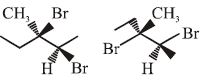
How are the following compounds related ?
Assign $A, B, C, D$ from given type of reaction. $CuO + {H_2} \longrightarrow Cu \downarrow  + {H_2}O$
The equilibrium constants for the reaction,
$\text{Zn(s)}+\text{Cu}^{2+}(\text{aq})\rightleftharpoons\text{Zn}^{2+}(\text{aq})+\text{Cu}(\text{s})\text{ and}$
$\text{Cu(s)}+2\text{Ag}^+(\text{aq})\rightleftharpoons\text{Cu}^{2+}(\text{aq})+2\text{Ag(s)}$
are K1 and K2 respectively. The equilibrium constant for the combined reaction is,