Question
i. A Why does the electric field inside a dielectric slab decrease when kept in an external electric field?
B. Derive an expression for the capacitance of a parallel plate capacitor filled with a medium of dielectric constant K.
ii. A charge $q =2 \mu C$ is placed at the centre of a sphere of radius 20 cm . What is the amount of work done in moving $4 \mu C$ from one point to another point on its surface?
iii. Write a relation for polarisation $\overrightarrow{ P }$ of a dielectric material in the presence of an external electric field.
Answer

i. A. A dielectric material gets polarized when it is placed in an external electric field. The field produced due to the polarization of material reduces the effect of external electric field. Hence, the electric field inside a dielectric decreases.
B. Electric field in vacuum between the plates $= E 0=\frac{\sigma}{\varepsilon_0}$
Electric field in dielectric between the plates, $E =\frac{E_0}{K}$
Potential difference between the capacitor plates
$V=E t+E_0(d-t)$
where 't' is the thickness of dielectric slab.
$\begin{array}{l} V =\frac{E_0}{K} t + E _0(d- t ) \\
V =\frac{\sigma}{\varepsilon_o}\left[\frac{t}{K}+( d - t )\right] \\
V =\frac{\sigma}{\varepsilon_o}\left[\frac{t+K(d-t)}{K}\right] \\
\text { As } C =\frac{Q}{V} \\
\Rightarrow C =\frac{\varepsilon_0 A K}{t+K(d-t)}\end{array}$

ii. The surface of the sphere is equipotential. So, the work done in moving the charge from one point to the other is zero.
$\begin{array}{l} W = q \Delta V (\because \Delta V =0) \\
=0\end{array}$

iii. $P =\chi E$

Need a full question paper?

Generate a complete, print-ready paper with questions like this in minutes — across 16+ boards, with answer keys.

Start Generating Free

Similar questions

A mica strip and a polysterene strip are fitted on the two slits of a double slit apparatus. The thickness of the strips is 0.50mm and the separation between the slits is 0.12cm. The refractive index of mica and polysterene are 1.58 and 1.55 respectively for the light of wavelength 590nm which is used in the experiment. The interference is observed on a screen a distance one meter away.
  1. What would be the fringe-width?
  2. At what distance from the centre will the first maximum be located?
4 × 10²³ tritium atoms are contained in a vessel. The half-life of decay tritium nuclei is 12.3y. Find:
  1. The activity of the sample.
  2. The number of decay in the next 10 hours.
  3. The number of decays in the next 6.15y.
A light beam of wavelength 400 run is incident on a metal plate of work function 2.2eV.
  1. A particular electron absorbs a photon and makes two collisions before coming out of the metal. Assuming that 10% of the extra energy is lost to the metal in each collision, find the kinetic energy of this electron as it comes out of the metal.
  2. Under the same assumptions, find the maximum number of collisions the electron can suffer before it becomes unable to come out of the metal.
Two heaters are marked 200V, 300W and 200V, 600W. If the heaters are connected in series and the combination connected to a 200V dc supply, which heater will produce more heat?
A horizontal cesium plate ($\phi$ = l.9 eV) is moved vertically downward at a constant speed u in a room full of radiation of wavelength 250 run and above. What should be the minimum value of u so that the vertically upward component of velocity is nonpositive for each photoelectron?
Two point charges of magnitude +q and -q are placed at $\Big(-\frac{\text{d}}{2},0,0\Big)$ and $\Big(\frac{\text{d}}{2},0,0\Big)$, respectively. Find the equation of the equipoential surface where the potential is zero.
A proton goes undeflected in a crossed electric and magnetic field (the fields are perpendicular to each other) at a speed of 2.0 × 10⁵ms-1. The velocity is perpendicular to both the fields. When the electric field is switched off, the proton moves along a circle of radius 4.0cm. Find the magnitudes of the electric and magnetic fields. Take the mass of the proton = 1.6 × 10⁻²⁷kg
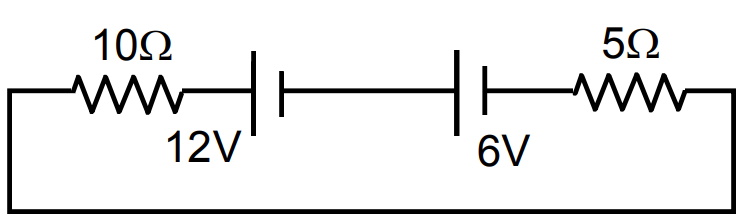
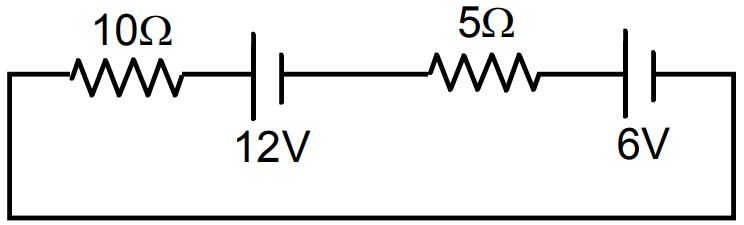
Consider the circuit shown in the figure. Find (a) the current in the circuit (b) the potential drop across the $5\Omega$ resistor (c) the potential drop across the $10\Omega$ resistor. (d) Answer the parts (a), (b) and (c) with reference to the figure.


Assume that there is no repulsive force between the electrons in an atom but the force between positive and negative charges is given by Coulomb’s law as usual. Under such circumstances, calculate the ground state energy of a He-atom.