Question
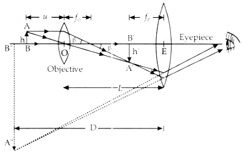
i. Draw a ray diagram showing the image formation by a compound microscope. Obtain the expression for total magnification when the image is formed at infinity.
ii. How does the resolving power of a compound microscope get affected, when
1. focal length of the objective is decreased.
2. the wavelength of light is increased ? Give reasons to justify your answer.
Answer

i. The ray diagram, showing image formation by a compound microscope, is given below ;-
Image
ii. Linear Magnification due to objective lens is given by $=\frac{\tan \beta}{\tan \alpha}$
$\begin{array}{l}\tan \beta=\frac{h^{\prime}}{L}=\frac{h}{f_o} \\
\frac{h^{\prime}}{h}=\frac{L}{f_0}\end{array}$
(where the distance between the second focal point of the objective and the first focal point of the eyepiece is called the tube length of the compound microscope and is denoted by L) The eyepiece will act as a simple microscope, hence we may use the formula of magnification by a simple microscope for normal adjustment.
$m_e=\frac{D}{f_e}$
Total magnification, $m = m _{ o } \times m _{ e }$
$=\frac{L}{f_o} \times \frac{D}{f_e} d_{\min }$
a. From the equation, it is clear that resolving power increases when the focal length of the objective is decreased. This is because the minimum separation, $d _{\min }$ decreases when f is decreased.
b. Resolving power decreases when the wavelength of light is increased. This is because the minimum separation, $d _{\text {min }}$ increases when $\lambda$ is increased.

Need a full question paper?

Generate a complete, print-ready paper with questions like this in minutes — across 16+ boards, with answer keys.

Start Generating Free

Similar questions

i. Define the capacitance of a capacitor. Obtain the expression for the capacitance of a parallel plate capacitor in vacuum in terms of plate area A and separation d between the plates.
ii. A slab of material of dielectric constant k has the same area as the plates of a parallel plate $\frac{3 d}{4}$ capacitor but has a thickness -. Find the ratio of the capacitance with dielectric inside it to its capacitance without the dielectric.
The electric field associated with a light wave is given by $\text{E}=\text{E}_0\sin[(1.57\times10^7\text{m}^{-1})(\text{x}-{\text{ct}})].$ Find the stopping potential when this light is used in an experiment on photoelectric effect with the emitter having work function 1.9eV.
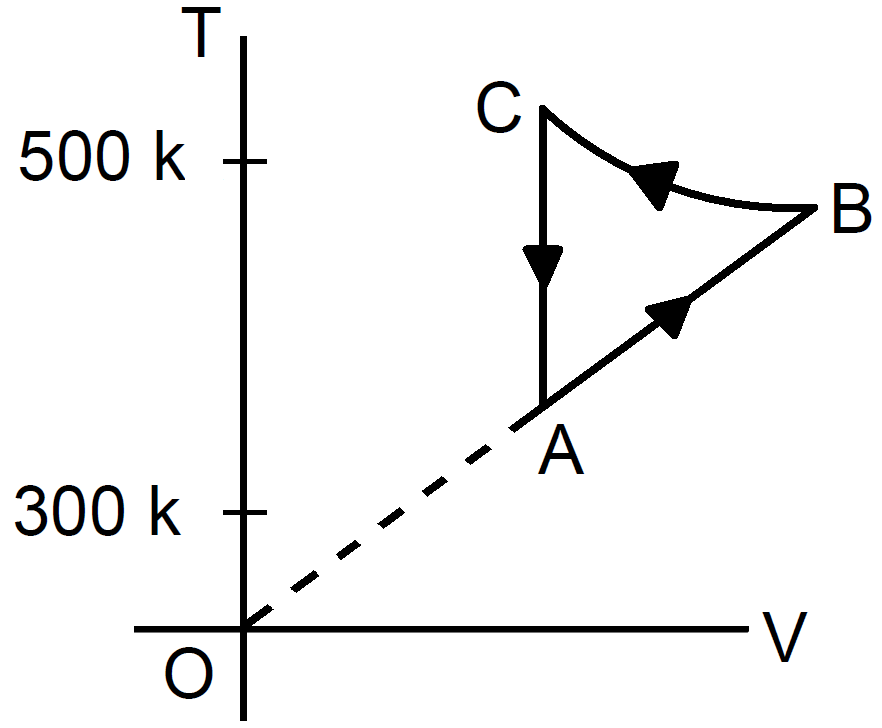
Consider the cyclic process ABCA, shown in figure. performed on a sample of 2.0 mol of an ideal gas. A total of 1200J of heat is withdrawn from the sample in the process. Find the work done by the gas during the part BC.

Describe the potential energy of an electric dipole in an external field in different positions also draw the diagram.
When a dielectric is placed in an electric field, it gets polarized. The electric field in a polarized material is less than the applied field. When a paramagnetic substance is kept in a magnetic field, the field in the substance is more than the applied field. Explain the reason of this opposite behaviour.
Two metal spheres, one of radius R and the other of radius 2R, both have same surface charge density $\sigma$. They are brought in contact and separated. What will be new surface charge densities on them?
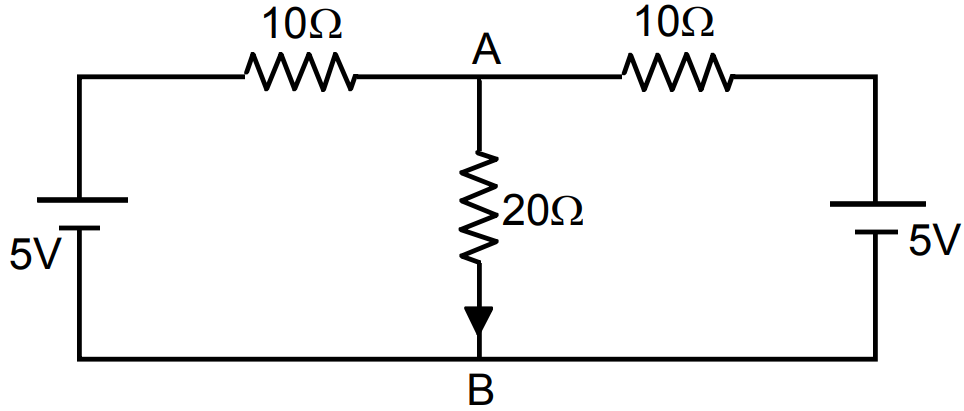
(a) Find the current in the $20\Omega$ resistor shown in the figure. (b) If a capacitor of capacitance $4\mu\text{F}$ is joined between the points A and B, what would be the electrostatic energy stored in it in steady state?

Assume that there is no repulsive force between the electrons in an atom but the force between positive and negative charges is given by Coulomb’s law as usual. Under such circumstances, calculate the ground state energy of a He-atom.
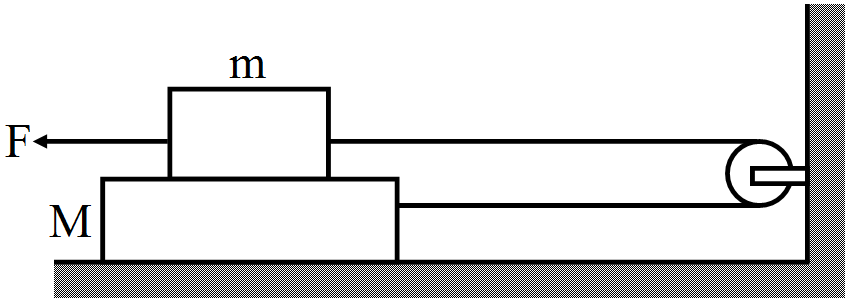
The friction coefficient between the two blocks shown in figure is $\mu$ but the floor is smooth.
  1. What maximum horizontal force F can be applied without disturbing the equilibrium of the system?
  2. Suppose the horizontal force applied is double of that found in part (a). Find the accelerations of the two masses.
​​​​​​​
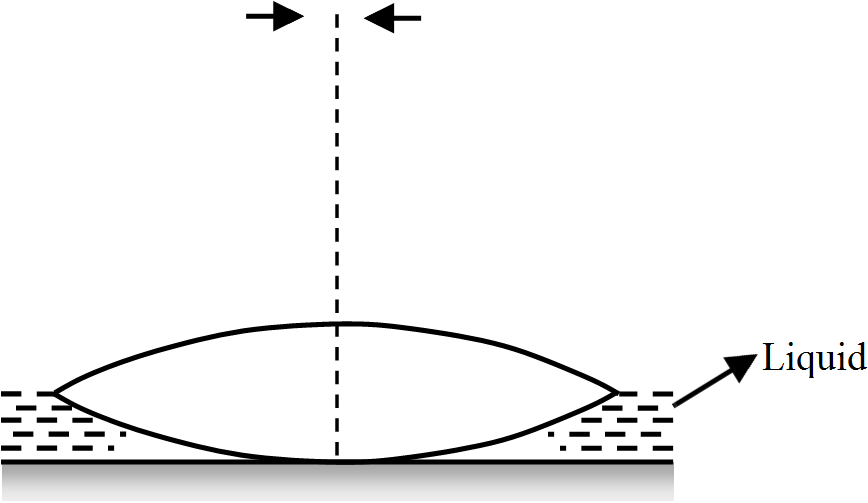
  1. An equiconvex lens with radii of curvature of magnitude r each, is put over a liquid layer poured on top of a plane mirror. A small needle, with its tip on the principal axis of the lens, is moved along the axis until its inverted real image coincides with the needle itself. The distance of the needle from the lens is measured to be 'a'. On removing the liquid layer and repeating the experiment the distance is found to be 'b'.

Given that two values of distances measured represent the focal length values in the two cases, obtain a formula for the refractive index of the liquid.

  1. If r = 10cm, a = 15cm, b = 10cm, find the refractive index of the liquid.