Question
(i) Explain chromatic aberration for spherical lenses. State a method to minimize or eliminate it.
(ii) What is achromatism? Derive a condition to achieve achromatism for a lens combination. State the conditions for it to be converging.
Answer

(i)Lenses are prepared by using a transparent material medium having different refractive index for different colours. Hence angular dispersion is present.
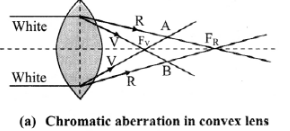
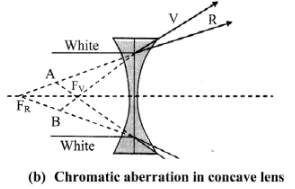
If the lens is thick, this will result into notably different foci corresponding to each colour for a polychromatic beam, like a white light. This defect is called chromatic aberration.
As violet light has maximum deviation, it is focussed closest to the pole.

Image
Image
Reducing/eliminating chromatic aberration:
  1. Eliminating chromatic aberrations for all colours is impossible. Hence, it is minimised by eliminating aberrations for extreme colours.
  2. This is achieved by using either a convex and a concave lens in contact or two thin convex lenses with proper separation. Such a combination is called achromatic combination.
    (ii)
    i. To eliminate chromatic aberrations for extreme colours from a lens, either a convex and a concave lens in contact or two thin convex lenses with proper separation are used.
    ii. This combination is called achromatic combination. The process of using this combination is termed as achromatism of a lens.
    iii. Let $ω_1$​​​​​​​ and $ω_2$​​​​​​​ be the dispersive powers of materials of the two component lenses used in contact for an achromatic combination.
    iv. Let $V, R$ and $Y$ denote the focal lengths for violet, red and yellow colours respectively.
    v. For lens $1$, let
    $K _1=\left(\frac{1}{R_1}-\frac{1}{R_2}\right)_1$ and $K _2=\left(\frac{1}{R_1}-\frac{1}{R_2}\right)_2$
    vi. For the combination to be achromatic, the resultant focal length of the combination must be the same for both the colours,
    $\therefore \quad f_V=f_R$
    $\therefore \quad \frac{1}{f_v}=\frac{1}{f_R}$
    For two thin lenses in contact, $\frac{1}{f}=\frac{1}{f_1}+\frac{1}{f_2}$
    $\therefore \quad \frac{1}{\left( f _{ v }\right)_1}+\frac{1}{\left( f _{ v }\right)_2}=\frac{1}{\left( f _{ R }\right)_1}+\frac{1}{\left( f _{ R }\right)_2}$
    vii. From Lens maker's formula,
    $ {\left[\left( n _{ V }\right)_1-1\right] K _1+\left[\left( n _{ v }\right)_2-1\right] K _2}$
    $ =\left[\left( n _{ R }\right)_1-1\right] K _1+\left[\left( n _{ R }\right)_2-1\right] K _2$
    $\therefore \quad  \frac{ K _1}{ K _2}=\frac{\left( n _{ v }\right)_2-\left( n _{ R }\right)_2}{\left( n _{ v }\right)_1-\left( n _{ R }\right)_1}$
    $\text { viii. }  \text { Similarly, for mean colour (yellow), }$
    $ \frac{1}{ f _{ r }}=\frac{1}{\left( f _{ r }\right)_1}+\frac{1}{\left( f _{ r }\right)_2}$
    $\frac{ K _1}{ K _2}=\frac{\left( n _{ Y }\right)_2-1}{\left( n _{ Y }\right)_1-1} \times \frac{\left( f _{ v }\right)_2}{\left( f _{ Y }\right)_1}$
    ix. From equations (1) and (3),
    $\frac{\left(f_{ r }\right)_2}{\left(f_{ Y }\right)_1}=-\frac{\left( n _{ V }\right)_2-\left( n _{ R }\right)_2}{\left( n _{ V }\right)_1-\left( n _{ R }\right)_1} \times \frac{\left( n _{ Y }\right)_2-1}{\left( n _{ Y }\right)_1-1}$
    Now, dispersive power $\omega_1=\frac{\left( n _{ V }\right)_2-\left( n _{ k }\right)_2}{\left( n _{ Y }\right)_2-1}$ and
    $\omega_2=\frac{\left( n _{ v }\right)_2-\left( n _{ n }\right)_2}{\left( n _{ Y }\right)_2-1}$
    x. Substituting values of $\omega_1$ and $\omega_2$ in equation (4), we get,
    $\frac{\left(f_{ Y }\right)_2}{\left(f_{ Y }\right)_1}=-\frac{\omega_2}{\omega_1}$
    This is the condition for achromatism of a combination of lenses.
    Condition for converging:
    For this combination to be converging, $fY$ must be positive.
    Using equation $(3)$, for $f_Y$​​​​​​​ to be positive, $(f_Y)_1 < (f_Y)_2 \Rightarrow ω_1 < ω_2$​​​​​​​

Need a full question paper?

Generate a complete, print-ready paper with questions like this in minutes — across 16+ boards, with answer keys.

Start Generating Free

Similar questions

Prove that relative permittivity is the ratio of the force between two point charges placed a certain distance apart in free space or vacuum to the force between the same two point charges when placed at the same distance in the given medium.
What would be the average duration of year if the distance between the Sun and the Earth becomes
$i)$ thrice the present distance.
$ii)$ twice the present distance.
How are microwaves produced? State their properties and uses.
Calculate and compare the electrostatic and gravitational forces between two protons which are $10^{-15} m$ apart. Value of $G = 6.674 \times 10^{-11} m^3 \ kg^{-1} s^{-2}$ and mass of the porton is $1.67 \times 10^{-27} \ kg.$
As i was standing on a weighing machine inside a lift it recorded $50 kg$ wt. Suddenly for few seconds it recorded $45 kg$ wt. What must have happened during that time? Explain with complete numerical analysis. [Ans: Lift must be coming down with acceleration $\frac{ g }{10}=$ $\left.1 ms ^{-2}\right]$
Explain ‘mirage’ as an illustration of refraction.
What is super conductivity?
(i) State the conditions under which a rainbow can be seen.
(ii) Explain the formation of a primary rainbow. For which angular range with the horizontal is it visible?
(iii) Explain the formation of a secondary rainbow. For which angular range with the horizontal is it visible?
(iv) Is it possible to see primary and secondary rainbow simultaneously? Under what conditions?
Find a vector which is parallel to $\overrightarrow{ v }=\hat{i}-2 \hat{j}$ and has a magnitude $10.$
Assume that the speed $(v)$ of sound in air depends upon the pressure $(P)$ and density $(\rho )$ of air, then use dimensional analysis to obtain an expression for the speed of sound.