Question
i. Predict the reaction, if any, between
a. zinc and silver nitrate solution,
b. magnesium and iron (II) chloride solution,
c. copper and magnesium sulphate solution.
Write the equations, with its physical form symbols, for the reaction.
ii. A lump of element X can be cut by a knife. During its reaction with water, X floats and melts. What is X? Explain.
Answer

i. a. Zinc is more reactive than silver. It will displace silver from silver nitrate solution and will form zinc nitrate in the
solution.
$Zn ( s )+2 AgNO _3( aq ) \rightarrow Zn \left( NO _3\right)_2( aq )+2 Ag ( s )$
b. Magnesium is more reactive than iron. It will displace iron from iron (II) chloride solution and will form magnesium
chloride in the solution.
$Mg ( s )+ FeCl _2( aq ) \rightarrow MgCl _2( aq )+ Fe ( s )$
c. Copper is less reactive than magnesium. It will not displace magnesium from magnesium sulphate solution and, hence, no
reaction will take place.
$Cu ( s )+ MgSO _4( aq ) \rightarrow$ No reaction
ii. X is potassium (K). Potassium is a soft metal that's why it can be cut with a knife and it is lighter than water that's why it floats
on the surface of water and the heat produced melts the potassium.

Need a full question paper?

Generate a complete, print-ready paper with questions like this in minutes — across 16+ boards, with answer keys.

Start Generating Free

Similar questions

How does the tendency of the elements to lose electrons change in the Modern Periodic Table in:
  1. a group,
  2. a period and why?
A spherical mirror produces an image of magnification -1 on a screen placed at a distance of 50cm from the mirror.
  1. Write the type of mirror.
  2. find the distance of the image from the object.
  3. What is the focal length of the mirror?
  4. Draw the ray diagram to show the image formation in this case.
What is an ammeter? How is it connected in a circuit? Draw a diagram to illustrate your answer.
What is the effect on the size and position of the image of moving the object:
  1. Towards the lens, and
  2. Away from the lens?
Explain the meanings of malleable and ductile.
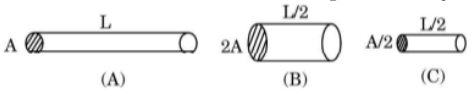
$i.$ In the following figure, three cylindrical conductors $A, B$ and $C$ are shown along with their lengths and areas of cross$-$section. If these three conductors are made of the same material and $R_A, R_B$ and $R_C$ be their respective resistances$,$ then find $(a) \frac{R_A}{R_B},$ and $(b) \frac{R_A}{R_C}$.

Image
$ii.$ If the conductor $A$ is made of copper and the conductor $C$ is made of constantan $($alloy of copper and nickel$),$ then which one of the two will have more electrical resistance and why?
State the 10% law, associated with the flow of energy in trophic levels of organisms.
A dentist’s mirror has a radius of curvature of 3cm. How far must it be placed from a small dental cavity to give a virtual image of the cavity that is magnified five times?
  1. List in tabular form two differences between binary fission and multiple fission.
  2. What happens when a mature Spirogyra filament attains considerable length.
A person walks across a room in barefeet and puts his foot on a drawing pin lying on the floor. He lets out a cry. Explain what happens in his nervous system in bringing about this response.