Maharashtra BoardEnglish MediumSTD 12 ScienceBIOLOGYMARCH 20243 Marks
Question
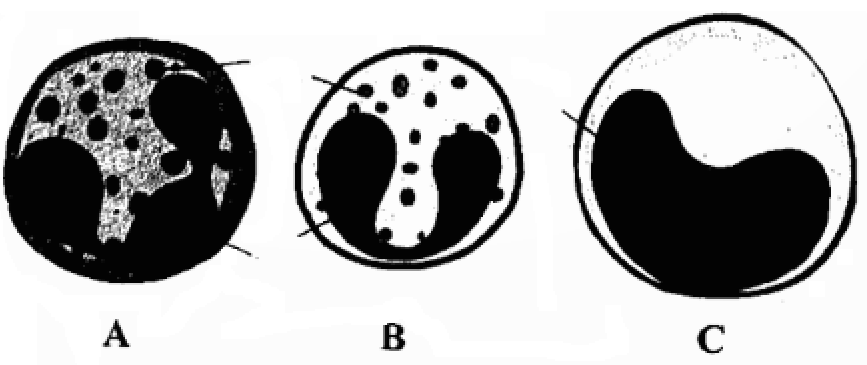
Identify A, B, and C from the above diagrams and give their functions.
✓
Answer
Diagrams A, B, and C represent three types of white blood cells (WBCs) with distinct functions:
A - Neutrophils: Neutrophils have fine granules that stain with neutral dyes, make up about 70% of total WBCs, and have a multi-lobed nucleus. They are able to move in an amoeboid manner and perform phagocytosis, playing a crucial role in destroying pathogens.
B - Eosinophils: Eosinophils contain lysosomal granules that are stained to red colour with acidic stains like eosin. Eosinophils are about 1 – 3 % of total WBCs. The nucleus is bilobed. They destroy antigen-antibody complex by phagocytosis. Their number increases in allergic condition and they show antihistaminic property. They are also responsible for detoxification as they produce antitoxins.
C - Monocytes: Monocytes are the largest of all the WBCs. Its nucleus is large and bean or kidney shaped. They form 3-5% of WBCs. Monocytes are actively motile and give rise to macrophages. They are mainly phagocytic and destroy the bacteria and dead or damaged tissue by phagocytosis.
Need a full question paper?
Generate a complete, print-ready paper with questions like this in minutes — across 16+ boards, with answer keys.