MCQ
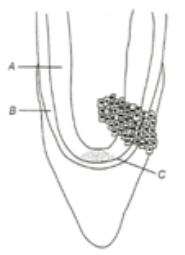
Identify $A, B$ and $C$ indicated in diagram of root apex given below
  • A
    $A-$ Vascular bundle, $B-$ Epidermis, $C-$ Root apical meristem
  • B
    $A-$ Cortex, $B-$ Epidermis, $C-$ Root apical meristem
  • $A-$ Cortex, $B-$ Protoderm, $C-$ Root apical meristem
  • D
    $A-$ Cortex, $B-$ Epidermis, $C-$ Root apical meristem

Answer

Correct option: C.
$A-$ Cortex, $B-$ Protoderm, $C-$ Root apical meristem
c

Need a full question paper?

Generate a complete, print-ready paper with questions like this in minutes — across 16+ boards, with answer keys.

Start Generating Free

Similar questions

Identify the diagram
The structures that help some bacteria to attach to rocks and for host tissues are:
Growth of plant is different from the growth of animals in
Which of the following is key features of meiosis ?
(i) Meiosis involves two sequential cycles of nuclear and cell division called meiosis-I and meiosis-II.
(ii) Meiosis-I is initiated after the parental chromosomes have replicated to produce identical sister chromatids at the S-phase.
(iii) Meiosis involves pairing of homologous chromosomes and recombination between them.
(iv) Four haploid cells are formed at the end of meiosis-II.
(v) Two cycle of DNA replication occurs.
When there are large number of post-reproductive or older individuals and lesser number of pre-reproductive individuals then that population is
Pollen grains can be stored for several years in liquid nitrogen having a temperature of
Assertion: Photosystem I (PS-I) and Photosystem II (PS-II) are part of light harvesting complexes (LHC).
Reason: Photosystem I (PS-I) and Photosystem II (PS-II) are named in the respiration.
In the naming of restriction enzymes the first letter is derived from$ ...A...$ name and next two letters from the $...B...$ and fourth letter from $...C...$ of $...D...$ where the enzymes are extracted

$A$ to $D$ in the statement can be

Correct sequence of rate of photosynthesis in different light is
After demonstration of totipotency, a botanist wishes to produce identical plants from an angiosperm by tissue culture. The parts or tissues which are likely to yield haploid embryos are