MCQ
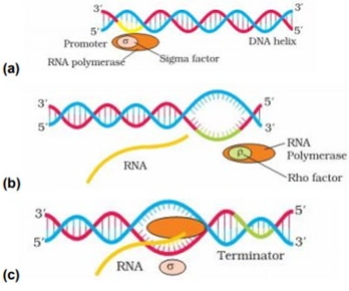
Identify $a, b$ and $c$
  • A
    $(a)$ Elongation, $(b)$ Termination, $(c)$ Initiation
  • $(a)$ Initiation, $(b)$ Termination, $(c)$ Elongation
  • C
    $(a)$ Initiation, $(b)$ Elongation, $(c)$ Termination
  • D
    $(a)$ Termination, $(b)$ Elongation, $(c)$ Initiation

Answer

Correct option: B.
$(a)$ Initiation, $(b)$ Termination, $(c)$ Elongation
b
The process of transcription occurs in three stages-initiation, elongation, followed by termination. The process occurs in the $5^{\prime}-3^{\prime}$ direction. During initiation the complex of $RNA$ polymerase, sigma factor and promoter is present at the beginning. It reaches in the middle during elongation. Finally, the complex is released at the time of termination.

Need a full question paper?

Generate a complete, print-ready paper with questions like this in minutes — across 16+ boards, with answer keys.

Start Generating Free

Similar questions

The photosystem connected with splitting of water is
$ A- $ Breaking down processes within the living organism is anabolism and synthesis is catabolism.

$R-$ The proteins would be degraded by proteases and the individual amino acids (after deamination) depending on their structure would enter the pathway at some stage within the Kreb's cycle or even as pyruvate or acetyl $Co\,A. $

In the life cycle of which group flagellated cells are not formed
Cytokinins..........
The common phase between aerobic and anaerobic respiration is called
If a cell has a chromosome number after first meiosis equal to $48$. The chromosome number in the daughter cells after the completion of meiosis will be
Enzymes that catalyse removal of groups from substrates by mechanism other than hydrolysis leaving double bonds.
Mark the given statements True (T) or False (F).
(i) Aristotle was the earliest scientist to attempt a more scientific basis for classification. He used complex morphological characters to classify plants into trees. shrubs and herbs.
(ii) Fungi have cellulose in their walls while green plants have chitin in cell wall.
(iii) According to five kingdom of classification, the unicellular prokaryotic organisms were placed in kingdom protista.
(iv) The classification system is not only based on morphological, physiological and reproductive similarities, but is also phylogenetic ie. is based on evolutionary relationships.
(v) Methanogens are present in the gut of several ruminant animals such as cows and buffaloes and they are responsible for the production of methane from the dung of these animals.
(vi) In Nostoc, site of oxygen fixation is heterocysts.
(vii) Cholera, tetanus, citrus canker are well known diseases caused by different bacteria.
(viii) Bacteria reproduce mainly by fission.
(ix) The mycoplasma are organisms that completely lack a cell wall. They are smallest living cells known and can survive without oxygen.
(x) Chrysophytes, Euglenoids and Slime moulds belong to kingdom protista.
Choose the correct option given below : -
Which of the following cell is totipotent
Which of the following organism form the decomposers