Question
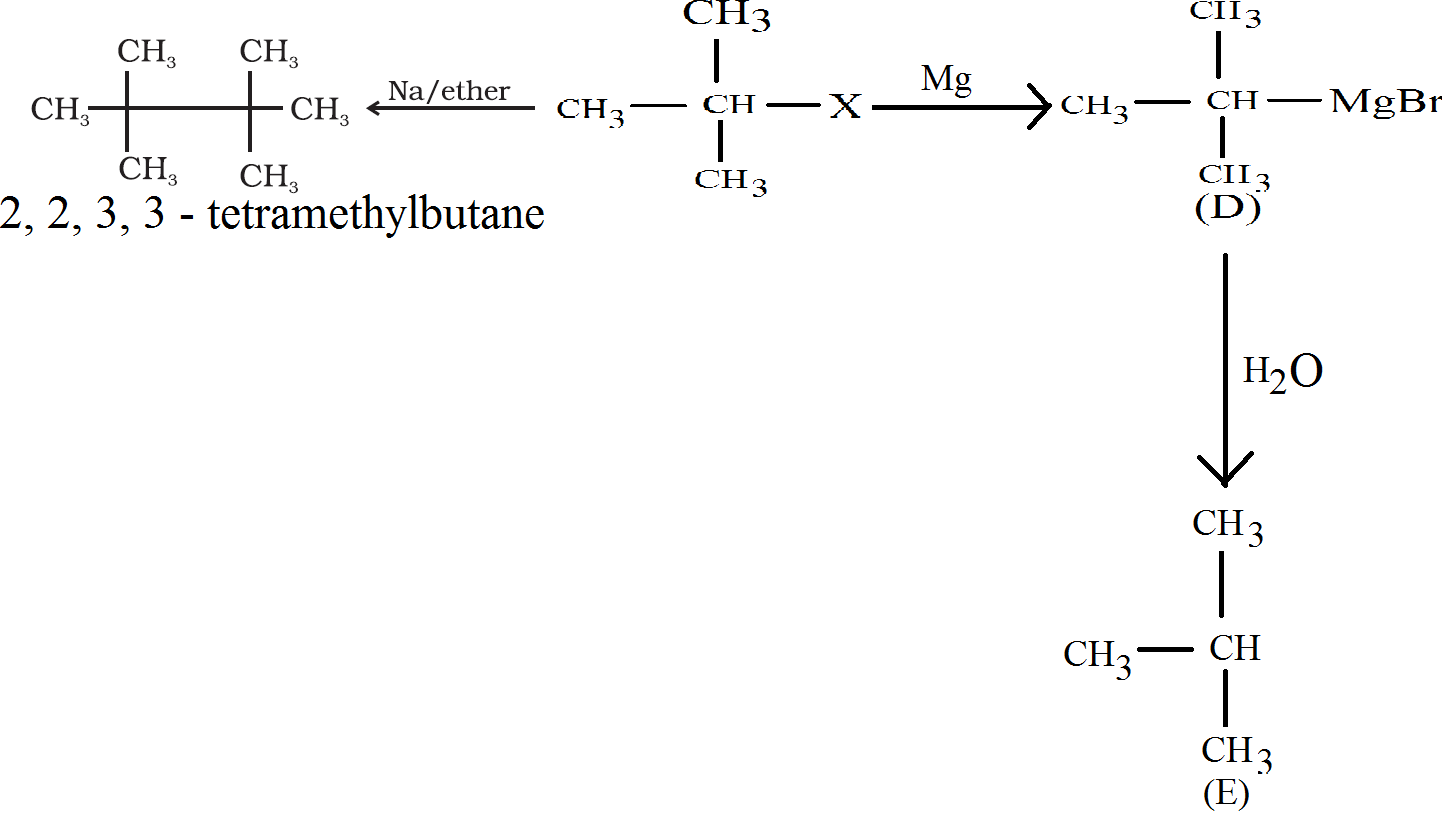
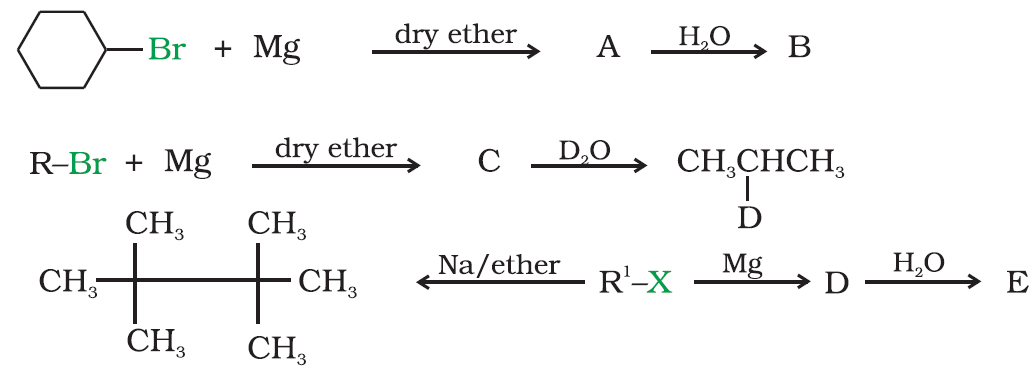
Identify $\text\{A, B, C, D, E, R\}$ and $R^1$ in the following:

Answer


Since $D$ of $D2O$ gets attached to the carbon atom to which $MgBr$ is attached, $C$ is
$\text{CH}_3\text{CHCH}_3\\\ \ \ \ \ \ \ \ \ |\\\ \ \ \ \ \ \ \text{MgBr}\\\text{Isopropylmagnesium bromide}$
Therefore, the compound $R - Br$ is
$\text{CH}_3\text{CHCH}_3\\\ \ \ \ \ \ \ \ \ |\\\ \ \ \ \ \ \ \text{Br}\\2-\text{Bromopropane}$
$\text{CH}_3\text{CHCH}_3+\text{Mg}\xrightarrow[]{\text{dry ether}}\text{CH}_3\text{CHCH}_3\xrightarrow[]{\text{D}_2\text{O}}\text{CH}_3\text{CHCH}_3\\\ \ \ \ \ \ \ \ \ |\ \ \ \ \ \ \ \ \ \ \ \ \ \ \ \ \ \ \ \ \ \ \ \ \ \ \ \ \ \ \ \ \ \ \ \ \ \ \ \ \ \ \ \ \ \ \ |\ \ \ \ \ \ \ \ \ \ \ \ \ \ \ \ \ \ \ \ \ \ \ \ \ \ \ \ \ \ |\\\ \ \ \ \ \ \ \ \text{Br}\ \ \ \ \ \ \ \ \ \ \ \ \ \ \ \ \ \ \ \ \ \ \ \ \ \ \ \ \ \ \ \ \ \ \ \ \ \ \ \ \ \ \text{MgBr}\ \ \ \ \ \ \ \ \ \ \ \ \ \ \ \ \ \ \ \ \ \ \ \text{D}\\\ \ \ \ \ \ \ \ \ \ \ \ \ \ \ \ \ \ \ \ \ \ \ \ \ \ \ \ \ \ \ \ \ \ \ \ \ \ \ \ \ \ \ \ \ \ \ \ \ \ \ \ \ \ \ (\text{C})$
When an alkyl halide is treated with $Na$ in the presence of ether, a hydrocarbon containing double the number of carbon atoms as present in the original halide is obtained as product. This is known as Wurtz reaction. Therefore, the halide, $R1-X,$ is
$\ \ \ \ \ \ \ \ \ \ \ \text{CH}_3\\\ \ \ \ \ \ \ \ \ \ \ \ \ |\\\text{CH}_3-\text{C}-\text{X}\\\ \ \ \ \ \ \ \ \ \ \ \ \ |\\\ \ \ \ \ \ \ \ \ \ \ \text{CH}_3\\\ \text{tert}-\text{Butylhalide}$
Therefore, compound $D$ is
$\ \ \ \ \ \ \ \ \ \ \ \text{CH}_3\\\ \ \ \ \ \ \ \ \ \ \ \ \ |\\\text{CH}_3-\text{C}-\text{MgBr}\\\ \ \ \ \ \ \ \ \ \ \ \ \ |\\\ \ \ \ \ \ \ \ \ \ \ \text{CH}_3\\\ \text{tert}-\text{Butylmagnesiumbromide}$
And, compound $E$ is
$\ \ \ \ \ \ \ \ \ \ \ \text{CH}_3\\\ \ \ \ \ \ \ \ \ \ \ \ \ |\\\text{CH}_3-\text{C}\\\ \ \ \ \ \ \ \ \ \ \ \ \ |\\\ \ \ \ \ \ \ \ \ \ \ \text{CH}_3\\2-\text{Methylpropane}$

Need a full question paper?

Generate a complete, print-ready paper with questions like this in minutes — across 16+ boards, with answer keys.

Start Generating Free

Similar questions

  1. A $10\%$ solution $($by mass$)$ of sucrose in water has a freezing point of $269.15 K$. Calculate the freezing point of $10\%$ glucose in water if the freezing point of pure water is $273.15 K.$ Given:
$($Molar mass of sucrose $= 342\ g\ mol^{-1})$
$($Molar mass of glucose $= 180\ g\ mol^{-1})$
  1. Define the following terms:
  1. Molality $(m)$
  2. Abnormal molar mass
  1. A blackish brown coloured solid $‘A’$ when fused with alkali metal hydroxides in presence of air, produces a dark green coloured compound $‘B’$, which on electrolytic oxidation in alkaline medium gives a dark purple coloured compound $C.$ Identify $A, B$ and $C$ and write the reactions involved.
  2. What happens when an acidic solution of the green compound $(B)$ is allowed to stand for some time? Give the equation involved. What is this type of reaction called?
Answer the following questions:
Draw the structures of chromate and dichromate ions.
The reaction between A and B is first order with respect to A and zero order with respect to B. Fill in the blanks in the following table :
Experiment$[ A ] / mol L ^{-1}$$[ B ] / mol L ^{-1}$Initial rate
$/ mol$ $L ^{-1} min^{-1}$
I0.10.1$2.0 \times 10^{-2}$
II-0.2$4.0 \times 10^{-2}$
III0.40.4-
IV-0.2$2.0 \times 10^{-2}$
Define the following modes of expressing the concentration of a solution. Which of these modes are independent of temperature and why?
  1. w/w (mass percentage)
  2. V/V (volume percentage)
  3. w/V (mass by volume percentage)
  4. ppm. (parts per million)
  5. x (mole fraction)
  6. M (Molarity)
  7. m (Molality)
(a) Differentiate between
a. Nucleotide and Nucleoside
b. Amylose and Amylopectin
(b) Write a reaction which shows that all the carbon atoms in glucose are linked in a straight chain.
(c) Write two differences between DNA and RNA.
(d) Amino acids can be classified as $\alpha-, \beta-, \gamma-, \delta-$ and so on depending upon the relative position of the amino group with respect to the carboxyl group. Which type of amino acids forms a polypeptide chain in proteins?
(e) What are any two good sources of vitamin A?
(f) What is anomeric carbon?
(g) What is the difference between a glycosidic linkage and a peptide linkage?
A hydrocarbon $'A', (C_4H_8)$ on reaction with $HCl$ gives a compound $'B', (C_4H_9Cl)$, which on reaction with $1 \ mol$ of $NH_3$ gives compound $'C', (C_4H_{11}N)$. On reacting with $NaNO_2$ and $HCl$ followed by treatment with water, compound $'C\ '$ yields an optically active alcohol,$'D\ '$. Ozonolysis of $'A\ '$ gives $2$ mols of acetaldehyde. Identify compounds $'A\ '$ to $'D\ '$. Explain the reactions involved.
Draw all the isomers of: (geometrical and optical)
i. $\left[ CoCl _2( en )_2\right]^{+}$
ii. $\left[ Co \left( NH _3\right) Cl ( en )^2\right]^{2+}$
iii. $\left[ Co \left( NH _3\right)_2 Cl _2( en )\right]^{+}$
Discus in detail the following $C - H$ bond cleavage reactions of ether :
(i) Peroxide formation
(ii) Halogenation
Match the complex ions given in Column $I$ with the colours given in Column $II$ and assign the correct code:
 
Column $I ($Complex ion$)$
 
Column $II ($Colour$)$
$a.$ $[Co(NH_3)_6]^{3+}$ $1.$
Violet
$b.$ $[Ti(H_2O)_6]^{3+}$ $2.$
Green
$c.$ $[Ni(H_2O)_6]^{2+}$ $3.$
Pale blue
$d.$ $[Ni(H_2O)_4(en)]^{2+} (aq)$ $4.$
Yellowish orange
 
 
$5.$
Blue
Code: