Question

Need a full question paper?
Generate a complete, print-ready paper with questions like this in minutes — across 16+ boards, with answer keys.
Explore more
Similar questions
In the reaction
Q + R → Products
The time taken for 99% reaction of Q is twice the time taken for 90% reaction of R. The concentration of R varies with time as shown in the figure given alongside.
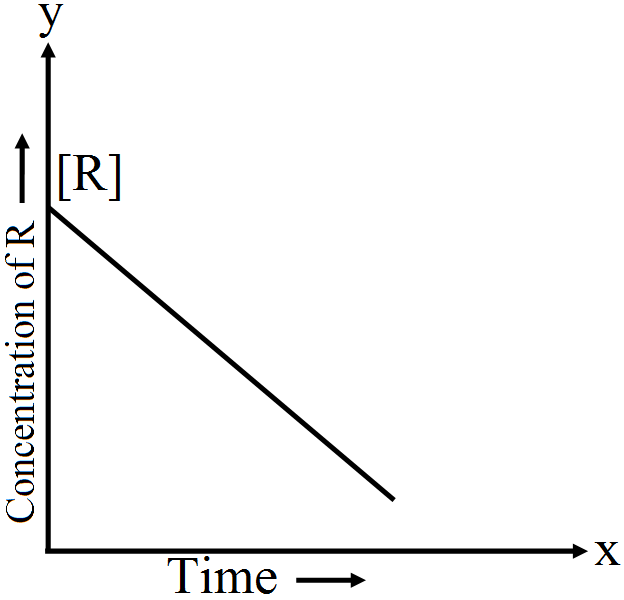
What is the overall order of the reaction? Give the units of the rate constant for the same. Write the rate expression for the above reaction.
Q + R → Products
The time taken for 99% reaction of Q is twice the time taken for 90% reaction of R. The concentration of R varies with time as shown in the figure given alongside.
What is the overall order of the reaction? Give the units of the rate constant for the same. Write the rate expression for the above reaction.
The activation energy of a reaction is 75.2kJ mol-1 in the absence of a catalyst and it lowers to 50.14kJ mol-1with a catalyst. How many times will the rate of reaction grow in the presence of a catalyst if the reaction proceeds at 25°C?
- 30 g of urea (M = 60 g mol-1) is dissolved in 846 g of water. Calculate the vapour pressure of water for this solution if vapour pressure of pure water at 298 K is 23.8 mm Hg.
- Write two differences between ideal solutions and non-ideal solutions.
Match the complex ions given in Column I with the hybridisation and number of unpaired electrons given in Column II and assign the correct code:
Code:
| | Column I (Complex ion) | | Column II (Hybridisation, number of unpaired electrons) |
| a. | [Cr(H2O)6]3+ | 1. | dsp2, 1 |
| b. | [Co(CN)4]2- | 2. | sp3d2, 5 |
| c. | [Ni(NH3)6]2+ | 3. | d2sp3, 3 |
| d. | [MnF6]4- | 4. | sp3, 4 |
| | | 5. | sp3d2, 2 |
- A (3), B (1), C (5), D (2).
- A (4), B (3), C (2), D (1).
- A (3), B (2), C (4), D (1).
- A (4), B (1), C (2), D (3).
- Answer the following questions briefly:
- What are any two good sources of vitamin A?
- What are nucleotides?
- Give an example of simple lipids.
- How are carbohydrates classified?
Primary alkyl halide C4H9Br (a) reacted with alcoholic KOH to give compound (b). Compound (b) is reacted with HBr to give (c) which is an isomer of (a). When (a) is reacted with sodium metal it gives compound (d), C8H18 which is different from the compound formed when n-butyl bromide is reacted with sodium. Give the structural formula of (a) and write the equations for all the reactions.
Explain the terms ideal and non-ideal solutions in the light of forces of interactions operating between molecules in liquid solutions.
(a) Why $\alpha$-hydrogen of carbonyl compound are acidic in nature?
(b) Explain aldol condensation reaction of ethanal.
→(b) Explain aldol condensation reaction of ethanal.
Describe the mechanism of replication of DNA.
Answer the following question:
0.6mL of acetic acid (CH3COOH), having density 1.06g mL-1, is dissolved in 1 litre of water. The depression in freezing point observed for this strength of acid was 0.0205°C. Calculate the van’t Hoff factor and the dissociation constant of acid.
0.6mL of acetic acid (CH3COOH), having density 1.06g mL-1, is dissolved in 1 litre of water. The depression in freezing point observed for this strength of acid was 0.0205°C. Calculate the van’t Hoff factor and the dissociation constant of acid.