MCQ
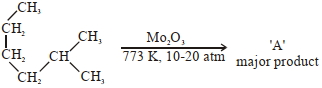
Identify $A$ in the given chemical reaction.
- A

- B

- C

- ✓

Generate a complete, print-ready paper with questions like this in minutes — across 16+ boards, with answer keys.
(Nearest integer)
(Use : $\Delta_{\mathrm{c}} \mathrm{H}($ glucose $)=-2700\, \mathrm{~kJ}\, \mathrm{~mol}^{-1}$ )
$(R= 8.314\,\,JK^{-1}\,\,mol^{-1};\,\,ln\,2 = 0.693;\,\,ln\,3 = 1.098)$
In the above reaction, $3.9\, g$ of benzene on nitration gives $4.92\, g$ of nitrobenzene. The percentage yield of nitrobenzene in the above reaction is............. $\%$. (Round off to the Nearest Integer).
(Given atomic mass: $C : 12.0\, u , H : 1.0\, u$$O : 16.0\, u , N : 14.0\, u )$
$4 HNO _{3}(l)+3 KCl ( s ) \rightarrow Cl _{2}( g )+ NOCl ( g )+ 2 H _{2} O ( g )+3 KNO _{3}( s )$
The amount of $HNO _{3}$ required to produce $110.0 \;g$ of $KNO _{3}$ is $...... \;g$
(Given : Atomic masses of $H , O , N$ and $K$ are $1 , 16,14$ and $39$ respectively.)