Question
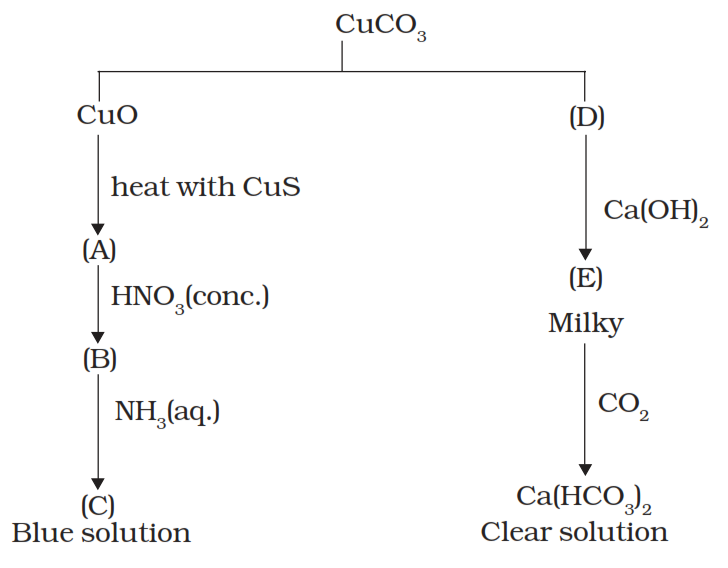
Identify $A$ to $E$ and also explain the reactions involved.
Answer

$\ce{A = CuB = Cu(NO_3)_2}$
$\ce{C = [Cu(NH_3)_4](NO_2)_2}$
$\ce{D = CO_2}$
$\ce{E = CaCO_3}$
$\ce{F = Cu_2[Fe(CN)_6]}$
$\ce{G = Ca(HCO_3)_2}$
$\text{CuCO}_3\rightarrow\text{CuO}+\text{CO}_2\\ \ \ \ \ \ \ \ \ \ \ \ \ \ \ \ \ \ \ \ \ \ \ \ \ \ \ \ \ \ \ \ \ \ \ ^{\text{(D)}}$
$\text{CuO}+\text{CuS}\rightarrow\text{Cu}+\text{SO}_2\\ \ \ \ \ \ \ \ \ \ \ \ \ \ \ \ \ \ \ \ \ \ \ \ \ \ \ \ \ ^{\text{(A)}}$
$\text{Cu}+\text{4HNO}_3\text{(Conc.)}\rightarrow[\text{Cu(NO}_3)_2+2\text{NO}+2\text{H}_2\text{O}\\ \ \ \ \ \ \ \ \ \ \ \ \ \ \ \ \ \ \ \ \ \ \ \ \ \ \ \ \ \ \ \ \ \ \ \ \ \ \ \ \ \ \ \ \ \ \ \ \ \ \ ^\text{(B)}$
$\text{Cu}^{2+}+\text{NH}_3\rightarrow[\text{Cu(NH}^3)^4]\\ \ \ \ ^\text{(B)} \ \ \ \ \ \ \ \ \ \ \ \ \ \ \ \ \ \ \ \ \ \ \ \ \ \ \ \ \ \ ^\text{(C)}$
$\text{Ca(OH})_2+\text{CO}_2\rightarrow\text{CaCO}_3+\text{H}_2\text{O}\\ \ \ \ \ \ \ \ \ \ \ \ \ \ \ \ \ \ \ \ \ ^\text{(D)} \ \ \ \ \ \ \ \ \ \ \ \ \ ^\text{(E)}$
$\text{CaCO}_3+\text{H}_2\text{O}+\text{CO}_2\rightarrow\text{Ca(HCO}_3)_2$

Need a full question paper?

Generate a complete, print-ready paper with questions like this in minutes — across 16+ boards, with answer keys.
Start Generating Free

Similar questions

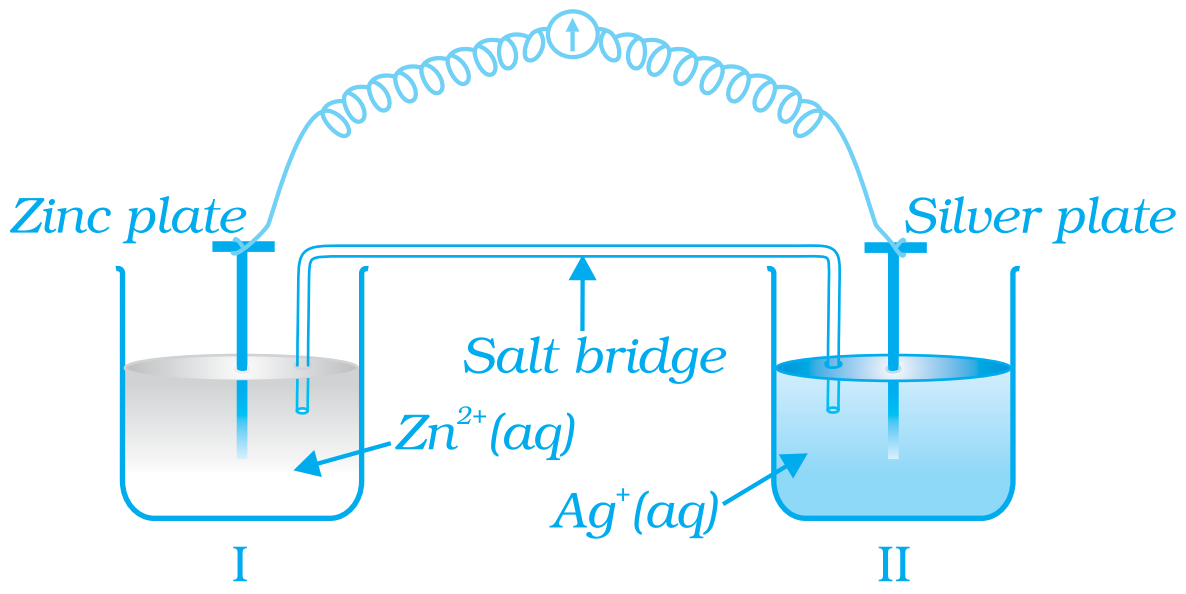
Consider and answer the questions $(i)$ to $(vi)$ given below.
  1. Redraw the diagram to show the direction of electron flow.
  2. Is silver plate the anode or cathode?
  3. What will happen if salt bridge is removed?
  4. When will the cell stop functioning?
  5. How will concentration of $Zn^{2+}$ ions and $Ag^+ $ ions be affected when the cell functions?
  6. How will the concentration of $Zn^{2+}$ ions and $Ag^+$ ions be affected after the cell becomes ‘dead’?
The rate constant for the decomposition of $\text{N_2O_5}$ at various temperatures is given below:
$T/^\circ C$ $0$ $20$ $40$ $60$ $80$
$105 \times k/s-1$ $0.0787$ $1.70$ $25.7$ $178$ $2140$
Draw a graph between ln $k$ and $1/T$ and calculate the values of $A$ and $E_a$. Predict the rate constant at $30^\circ$ and $50^\circ C.$
Write the chemical reactions of $C _2 H _5 OH$ with following compounds :
(i) $CH _2 N_2$ (diazomethane) (ii) ketone, (iii) $HC \equiv$ $C H$ (iv) $C H _3 N C O$ (Methyl-isocyanate) (v) $C H _3 C H O$ (ethanol) (vi) conc. $H _2 SO _4$ at $0^{\circ} C$.
Answer the following questions:
Give reasons:
  1. d-block elements exhibit more oxidation states than f-block elements.
  2. Orange solution of potassium dichromate turns yellow on adding sodium hydroxide to it.
  3. Zirconium (Z = 40) and Hafnium (Z = 72) have almost similar atomic radii.

Predict the reagents or the products in the following reaction sequence:

Specify the oxidation numbers of the metals in the following coordination entities:
i. $\left[ Co \left( H _2 O \right)( CN )( en )_2\right]^{2+}$
ii. $\left[ Pt ( Cl )_4\right]^{2-}$
iii. $K _3\left[ Fe ( CN )_6\right]$
iv. $\left[ Cr \left( NH _3\right)_3 Cl _3\right]$
Match the complex ions given in Column $I$ with the colours given in Column $II$ and assign the correct code:
 
Column $I ($Complex ion$)$
 
Column $II ($Colour$)$
$a.$ $[Co(NH_3)_6]^{3+}$ $1.$
Violet
$b.$ $[Ti(H_2O)_6]^{3+}$ $2.$
Green
$c.$ $[Ni(H_2O)_6]^{2+}$ $3.$
Pale blue
$d.$ $[Ni(H_2O)_4(en)]^{2+} (aq)$ $4.$
Yellowish orange
 
 
$5.$
Blue
Code:
  1. Why do transition elements show variable oxidation states?
  1. Name the element showing maximum number of oxidation states among the first series of transition metals form Sc (Z=21) to Zn (Z=30).
  2. Name the element which shows only +3 oxidation state.
  1. What is lanthanoid contraction? Name an important alloy which contains some of the lanthanoid metals.
i. Give reasons :
a. Although $- \ce{NH2}$ group is o/p directing in electrophilic substitution reactions, yet aniline, on nitration gives good yield of $m-$nitroaniline.
b. $(\ce{CH 3)2NH}$ is more basic than $(\ce{CH3)3N}$ in an aqueous solution.
c. Ammonolysis of alkyl halides is not a good method to prepare pure primary amines.
ii. Distinguish between the following:
a. $\ce{CH 3 CH 2 NH 2}$ and $(\ce{CH 3 CH 2)2NH}$
b. Aniline and $\ce{CH3NH2}$
Two elements A and B form compounds having formula AB2 and AB4. When dissolved in 20 g of benzene $\left( C _6 H _6\right), 1 g$ of $AB _2$ lowers the freezing point by 2.3 K whereas 1.0 g of AB4 lowers it by 1.3 K. The molar depression constant for benzene is 5.1 K kg mol-1. Calculate atomic masses of A and B.