Answer

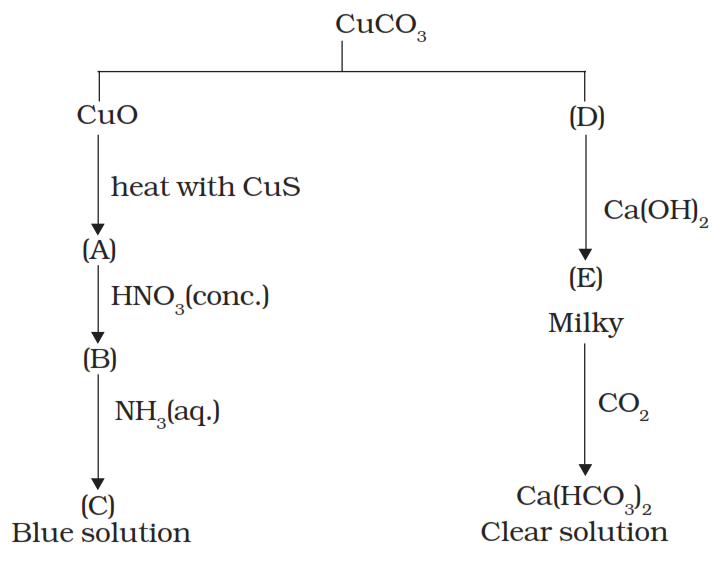
A = Cu

B = Cu(NO3)2

C = [Cu(NH3)4](NO2)2

D = CO2

E = CaCO3

F = Cu2[Fe(CN)6]

G = Ca(HCO3)2

$\text{CuCO}_3\rightarrow\text{CuO}+\text{CO}_2\\ \ \ \ \ \ \ \ \ \ \ \ \ \ \ \ \ \ \ \ \ \ \ \ \ \ \ \ \ \ \ \ \ \ \ ^{\text{(D)}}$

$\text{CuO}+\text{CuS}\rightarrow\text{Cu}+\text{SO}_2\\ \ \ \ \ \ \ \ \ \ \ \ \ \ \ \ \ \ \ \ \ \ \ \ \ \ \ \ \ ^{\text{(A)}}$

$\text{Cu}+\text{4HNO}_3\text{(Conc.)}\rightarrow[\text{Cu(NO}_3)_2+2\text{NO}+2\text{H}_2\text{O}\\ \ \ \ \ \ \ \ \ \ \ \ \ \ \ \ \ \ \ \ \ \ \ \ \ \ \ \ \ \ \ \ \ \ \ \ \ \ \ \ \ \ \ \ \ \ \ \ \ \ \ ^\text{(B)}$

$\text{Cu}^{2+}+\text{NH}_3\rightarrow[\text{Cu(NH}^3)^4]\\ \ \ \ ^\text{(B)} \ \ \ \ \ \ \ \ \ \ \ \ \ \ \ \ \ \ \ \ \ \ \ \ \ \ \ \ \ \ ^\text{(C)}$

$\text{Ca(OH})_2+\text{CO}_2\rightarrow\text{CaCO}_3+\text{H}_2\text{O}\\ \ \ \ \ \ \ \ \ \ \ \ \ \ \ \ \ \ \ \ \ ^\text{(D)} \ \ \ \ \ \ \ \ \ \ \ \ \ ^\text{(E)}$

$\text{CaCO}_3+\text{H}_2\text{O}+\text{CO}_2\rightarrow\text{Ca(HCO}_3)_2$

Need a full question paper?

Generate a complete, print-ready paper with questions like this in minutes — across 16+ boards, with answer keys.
Start Generating Free

Similar questions

  1. How do you prepare:
  1. K2MnO4 from MnO2?
  2. Na2Cr2O7 form Na2CrO4?
  1. Account for the following:
  1. Mn2+ is more stable than Fe2+ towards oxidation to +3 state.
  2. The enthalpy of atomization is lowest for Zn in 3d series of the transition elements.
  3. Actinoid elements show wide range of oxidation states.
The rate constant for the first order decomposition of H2O2 is given by the following equation:
log k = 14.34 – 1.25 × 10⁴K/T
Calculate Ea for this reaction and at what temperature will its half-period be 256 minutes?
A voltaic cell is set up at 25°C with the followinng half-cell:
Al | Al3+ (0.001M) and Ni | Ni2+ (0.50M)
Calculate the cell voltage $\text{E}^{\circ}_{\text{Ni}^{2+}/\text{Ni}}\Big[=-0.25\text{V,E}^{\circ}_{\text{Al}^{3+}/\text{Al}}=-1.66\text{V}\Big]$
Answer the following questions:
Is the variability in oxidation number of transition elements different from that of non–transition elements? Illustrate with examples.
What is crystal field theory? On the basis of this, explain the crystal field splitting in octahedral coordinaton compounds.
Answer the following questions.
Write chemical reaction to show that glucose contains aldehyde as carbonyl group.
Answer the following questions:
Give chemical reactions for the following observations:
  1. Potassium permanganate is a good oxidising agent in basic medium.
  2. Inter convertibility of chromate ion and dichromate ion in aqueous solution depends upon pH of the solution.
  3. Potassium permanganate is thermally unstable at 513K.
Differentiate between $1^{\circ}, 2^{\circ}$ and $3^{\circ}$ alcohols by catalytic dehydrogenation.
Explain the different methods of preparing haloakanes from alcohols.
How are different aromatic compounds synthesized by benzene diazonium chloride? Explain with examples.