Question
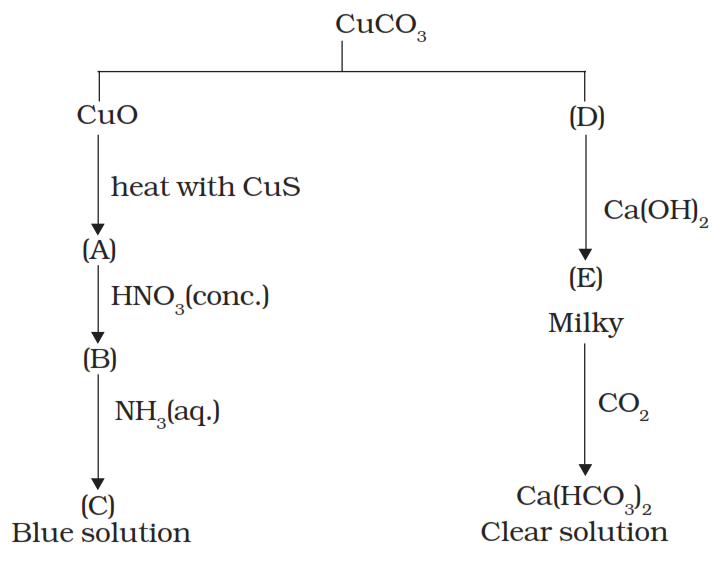
✓
Answer
A = Cu
B = Cu(NO3)2
C = [Cu(NH3)4](NO2)2
D = CO2
E = CaCO3
F = Cu2[Fe(CN)6]
G = Ca(HCO3)2
$\text{CuCO}_3\rightarrow\text{CuO}+\text{CO}_2\\ \ \ \ \ \ \ \ \ \ \ \ \ \ \ \ \ \ \ \ \ \ \ \ \ \ \ \ \ \ \ \ \ \ \ ^{\text{(D)}}$
$\text{CuO}+\text{CuS}\rightarrow\text{Cu}+\text{SO}_2\\ \ \ \ \ \ \ \ \ \ \ \ \ \ \ \ \ \ \ \ \ \ \ \ \ \ \ \ \ ^{\text{(A)}}$
$\text{Cu}+\text{4HNO}_3\text{(Conc.)}\rightarrow[\text{Cu(NO}_3)_2+2\text{NO}+2\text{H}_2\text{O}\\ \ \ \ \ \ \ \ \ \ \ \ \ \ \ \ \ \ \ \ \ \ \ \ \ \ \ \ \ \ \ \ \ \ \ \ \ \ \ \ \ \ \ \ \ \ \ \ \ \ \ ^\text{(B)}$
$\text{Cu}^{2+}+\text{NH}_3\rightarrow[\text{Cu(NH}^3)^4]\\ \ \ \ ^\text{(B)} \ \ \ \ \ \ \ \ \ \ \ \ \ \ \ \ \ \ \ \ \ \ \ \ \ \ \ \ \ \ ^\text{(C)}$
$\text{Ca(OH})_2+\text{CO}_2\rightarrow\text{CaCO}_3+\text{H}_2\text{O}\\ \ \ \ \ \ \ \ \ \ \ \ \ \ \ \ \ \ \ \ \ ^\text{(D)} \ \ \ \ \ \ \ \ \ \ \ \ \ ^\text{(E)}$
$\text{CaCO}_3+\text{H}_2\text{O}+\text{CO}_2\rightarrow\text{Ca(HCO}_3)_2$
Need a full question paper?
Generate a complete, print-ready paper with questions like this in minutes — across 16+ boards, with answer keys.
Explore more
Similar questions
Write the $S _{ N } 1$ mechanism of unimolecular nucleophilic substitution reaction.
→Prove that the relative depression of vapour pressure is equal to the mole fraction of solute.
Explain the collision principle of any chemical reaction.
State Henry's law and mention some important applications.
The following results have been obtained during the kinetic studies of the reaction :
$2 A+ B \rightarrow C + D$
Determine the rate law and the rate constant for the reaction.
→$2 A+ B \rightarrow C + D$
| Experiment | $[ A ] / mol L ^{-1}$ | $[ B ] / mol L ^{-1}$ | Initial rate of formation of D $/ mol L ^{-1} min^{-1}$ |
| I | 0.1 | 0.1 | $6.0 \times 10^{-3}$ |
| II | 0.3 | 0.2 | $7.2 \times 10^{-2}$ |
| III | 0.3 | 0.4 | $2.88 \times 10^{-1}$ |
| IV | 0.4 | 0.1 | $2.40 \times 10^{-2}$ |
Discuss the nature of bonding in the following coordination entities on the basis of valence bond theory :
(i) $\left[ Fe ( CN )_6\right]^{4-}$
(ii) $\left[ FeF _6\right]^{3-}$
(iii) $\left[ Co \left( C _2 O _4\right)_3\right]^{3-}$
(iv) $\left[ CoF _6\right]^{3-}$
→(i) $\left[ Fe ( CN )_6\right]^{4-}$
(ii) $\left[ FeF _6\right]^{3-}$
(iii) $\left[ Co \left( C _2 O _4\right)_3\right]^{3-}$
(iv) $\left[ CoF _6\right]^{3-}$
Describe the differences in the properties of lanthanoids and actinoids.
Match the graph given in Column I with the order of reaction given in Column II. More than one item in Column I may link to the same item of Column II.
Column I | Column II | ||
(i) | 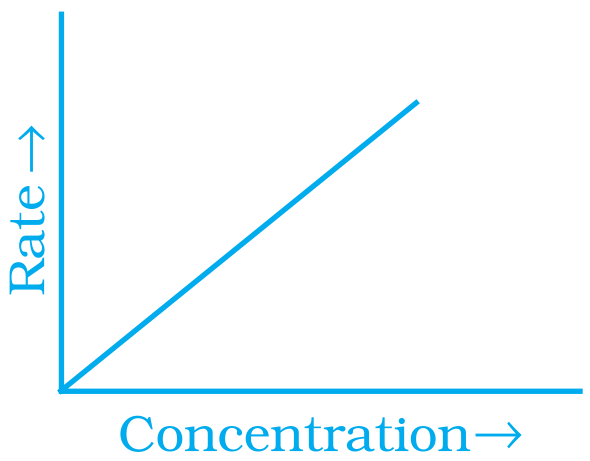 | ||
(ii) | 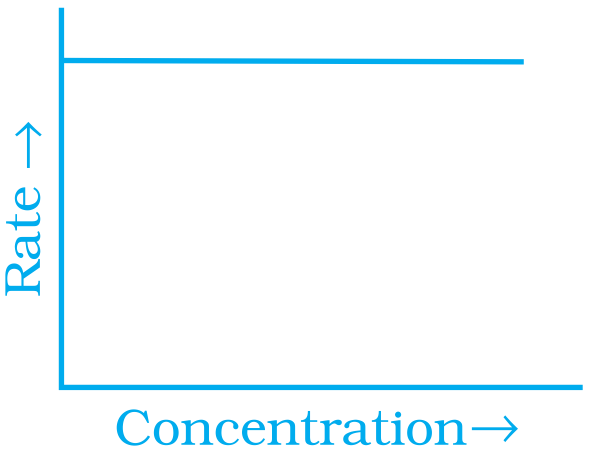 | (a) | Ist order |
(iii) | 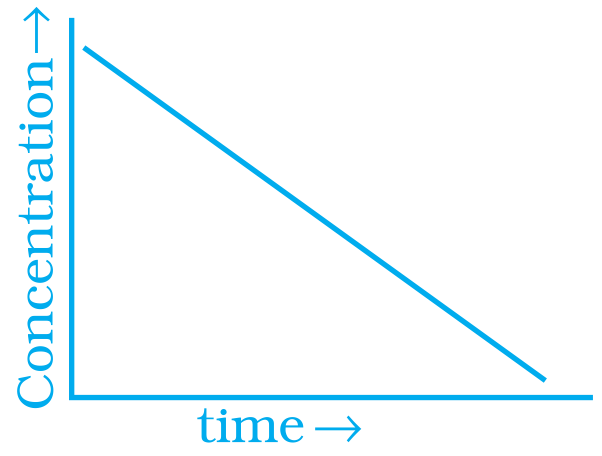 | (b) | Zero order |
(iv) | 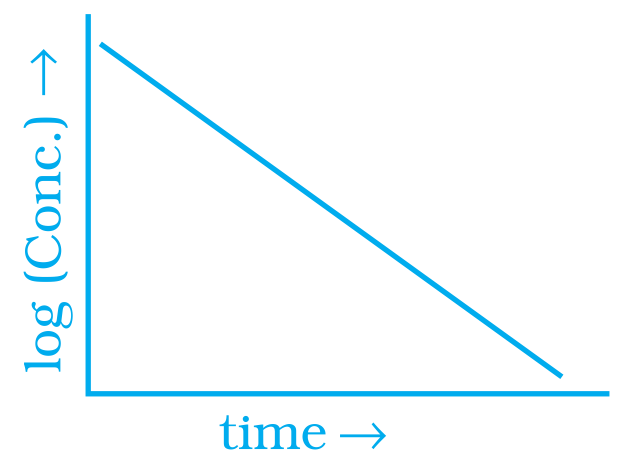 |
Write the formulas for the following coordination compounds:
a. Tetraammineaquachloridocobalt(III) chloride
b. Potassium tetrahydroxidozincate(II)
c. Potassium trioxalatoaluminate(III)
d. Dichloridobis(ethane-1, 2-diamine)cobalt(III)
e. Tetracarbonylnickel(0)
a. Tetraammineaquachloridocobalt(III) chloride
b. Potassium tetrahydroxidozincate(II)
c. Potassium trioxalatoaluminate(III)
d. Dichloridobis(ethane-1, 2-diamine)cobalt(III)
e. Tetracarbonylnickel(0)
The air is a mixture of a number of gases. The major components are oxygen and nitrogen with approximate proportion of 20% is to 79% by volume at 298 K. The water is in equilibrium with air at a pressure of 10 atm. At 298 K if the Henry’s law constants for oxygen and nitrogen at 298 K are 3.30 × 107 mm and 6.51 × 107 mm respectively, calculate the composition of these gases in water.