Question

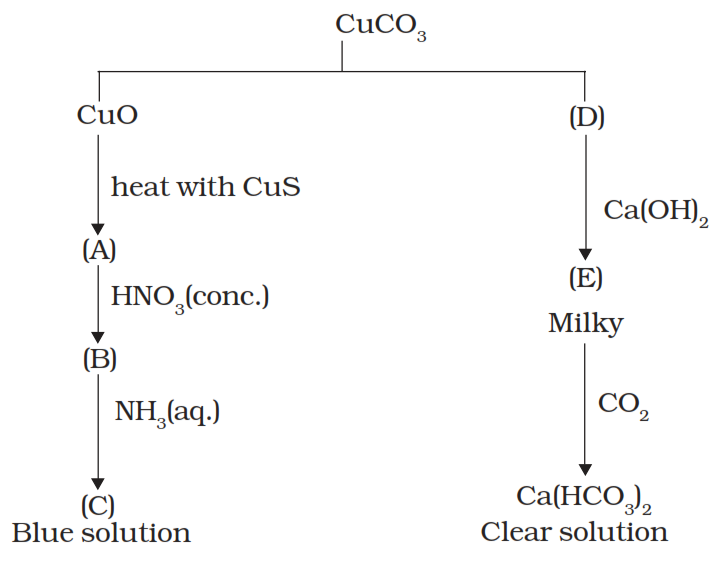
Identify $A$ to $E$ and also explain the reactions involved.

Answer

$A = CuB = Cu(NO_3)_2$
$C = [Cu(NH_3)_4](NO_2)_2$
$D = CO_2$
$E = CaCO_3$
$F = Cu_2[Fe(CN)_6]$
$G = Ca(HCO_3)_2$
$\text{CuCO}_3\rightarrow\text{CuO}+\text{CO}_2\\ \ \ \ \ \ \ \ \ \ \ \ \ \ \ \ \ \ \ \ \ \ \ \ \ \ \ \ \ \ \ \ \ \ \ ^{\text{(D)}}$
$\text{CuO}+\text{CuS}\rightarrow\text{Cu}+\text{SO}_2\\ \ \ \ \ \ \ \ \ \ \ \ \ \ \ \ \ \ \ \ \ \ \ \ \ \ \ \ \ ^{\text{(A)}}$
$\text{Cu}+\text{4HNO}_3\text{(Conc.)}\rightarrow[\text{Cu(NO}_3)_2+2\text{NO}+2\text{H}_2\text{O}\\ \ \ \ \ \ \ \ \ \ \ \ \ \ \ \ \ \ \ \ \ \ \ \ \ \ \ \ \ \ \ \ \ \ \ \ \ \ \ \ \ \ \ \ \ \ \ \ \ \ \ ^\text{(B)}$
$\text{Cu}^{2+}+\text{NH}_3\rightarrow[\text{Cu(NH}^3)^4]\\ \ \ \ ^\text{(B)} \ \ \ \ \ \ \ \ \ \ \ \ \ \ \ \ \ \ \ \ \ \ \ \ \ \ \ \ \ \ ^\text{(C)}$
$\text{Ca(OH})_2+\text{CO}_2\rightarrow\text{CaCO}_3+\text{H}_2\text{O}\\ \ \ \ \ \ \ \ \ \ \ \ \ \ \ \ \ \ \ \ \ ^\text{(D)} \ \ \ \ \ \ \ \ \ \ \ \ \ ^\text{(E)}$
$\text{CaCO}_3+\text{H}_2\text{O}+\text{CO}_2\rightarrow\text{Ca(HCO}_3)_2$

Need a full question paper?

Generate a complete, print-ready paper with questions like this in minutes — across 16+ boards, with answer keys.
Start Generating Free

Similar questions

Arrange the following compounds in a decreasing order of basic strength in their aqueous solutions.
$NH_3, CH_3NH_2, (CH_3)_2NH, (CH_3)_3N$
  1. Name the three major classes of carbohydrates and give an example of each of these classes.
  2. Answer the following:
  1. What type of linkage is responsible for the primary structure of proteins?
  2. Name the location where protein synthesis occurs in our bod.
Attempt any five of the following:
(a) Which sugar is present in milk?
(b) Why must vitamin C be supplied regularly in diet?
(c) What type of substance is phenylanine hydroxylate? Write its importance.
(d) Define denaturation of protein. What is the effect of denaturation on the structure of protein?
(e) Name the linkage connecting monosaccharide units in polysaccharides.
(f) How do you explain the presence of all six carbon atoms in glucose in a straight chain?
(g) Write the reactions showing the presence of following in the open structure of glucose:
i. a carbonyl group
ii. chain with six carbon atoms
Due to hectic and busy schedule, Mr. Awasthi made his life full of tensions and anxiety. He started taking sleeping pills to overcome the depression without consulting the doctor. Mr. Roy, a close friend of Mr. Awasthi, advised him to stop taking sleeping pills and suggested to change his lifestyle by doing Yoga, meditation and some physical exercise. Mr. Awasthi followed his friend’s advice and after few days he started feeling better.
After reading the above passage, answer the following:
  1. What are the values (at least two) displayed by Mr. Roy?
  2. Why it is not advisable to take sleeping pills without consulting doctor?
  3. What are tranquillizers? Give two examples.
(a) Differentiate between
a. Nucleotide and Nucleoside
b. Amylose and Amylopectin
(b) Write a reaction which shows that all the carbon atoms in glucose are linked in a straight chain.
(c) Write two differences between DNA and RNA.
(d) Amino acids can be classified as $\alpha-, \beta-, \gamma-, \delta-$ and so on depending upon the relative position of the amino group with respect to the carboxyl group. Which type of amino acids forms a polypeptide chain in proteins?
(e) What are any two good sources of vitamin A?
(f) What is anomeric carbon?
(g) What is the difference between a glycosidic linkage and a peptide linkage?
Answer the following question:
Account for the following:
  1. $SnCl_4$​​​​​​​ is more covalent than $SnCl_2​​​​​​​$​​​​​​​.
  2. Tendency to form pentahalides decreases down the group in group $15$ of the periodic table.
Due to hectic and busy schedule, Mr. Singh started taking junk food in the lunch break and slowly became habitual of eating food irregularly to excel in his field. One day during meeting he felt severe chest pain and fell down. Mr. Khanna, a close friend of Mr. Singh took him to doctor immediately. The doctor diagnosed that Mr. Singh was suffering from acidity and prescribed some medicines. Mr. Khanna advised him to eat homemade food and change his lifestyle by doing yoga, meditation and some physical exercise. Mr. Singh followed his friend's advice and after few days he started feeling better. After reading the above passage, answer the following:
  1. What are the values (at least two) displayed by Mr. Khanna?
  2. What are antacids? Give one example.
  3. Would it be advisable to take antacids for a long period of time? Give reason.
  1. Give reasons for the following:
  1. Bond enthalpy of $f_2$ is lower than that of $Cl_2$.
  2. $PH_3$ has lower boiling point than $NH_3$​​​​​​​.
  1. Draw the structures of the following molecules:
  1. $BrF_{3.}$
  2. $(HPO_3)_{3.}$
  3. $XeF_{4.}$​​​​​​​
What is abnormal molar mass? Explain.
  1. Explain the following:
  1. $NF_3$ is an exothermic compound whereas $NCl_3$ is not.
  2. $F_2$ is most reactive of all the four common halogens.
  1. Complete the following chemical equations:
  1. $C + H_2SO_4 (conc.)\rightarrow $
  2. $P_4 + NaOH + H_2O\rightarrow $
  3. $Cl_2 + F_2 \rightarrow $
(excess)