Question
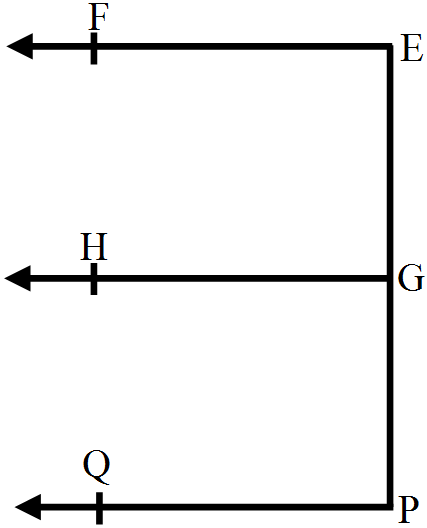
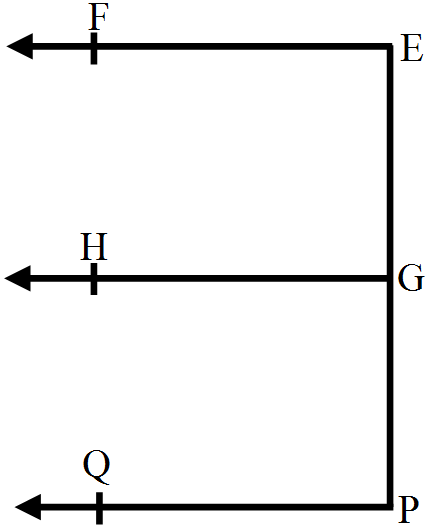
Identify and name the line segments and rays in the following figure:
Answer


Line segments are:
$\overline{\text{EP}}$
This is because it has two end point E and P.
$\overline{\text{EG}}$
This is because it has two end point E and G.
$\overline{\text{GP}}$
This is because it has two end point G and P.
Rays are:
$\overrightarrow{\text{EF}}$
This is because it has only one end point E.
$\overrightarrow{\text{GH}}$
This is because it has only one end point G.
$\overrightarrow{\text{PQ}}$
This is because it has only one end point P.

Need a full question paper?

Generate a complete, print-ready paper with questions like this in minutes — across 16+ boards, with answer keys.

Start Generating Free

Similar questions

Match the equivalent fractions and write another 2 for each:
(i) $\frac{250}{400}$ (a) $\frac{2}{3}$
(ii) $\frac{180}{200}$ (b) $\frac{2}{5}$
(iii) $\frac{660}{990}$ (c) $\frac{1}{2}$
(iv) $\frac{180}{360}$ (d) $\frac{5}{8}$
(v) $\frac{220}{550}$ (e) $\frac{9}{10}$
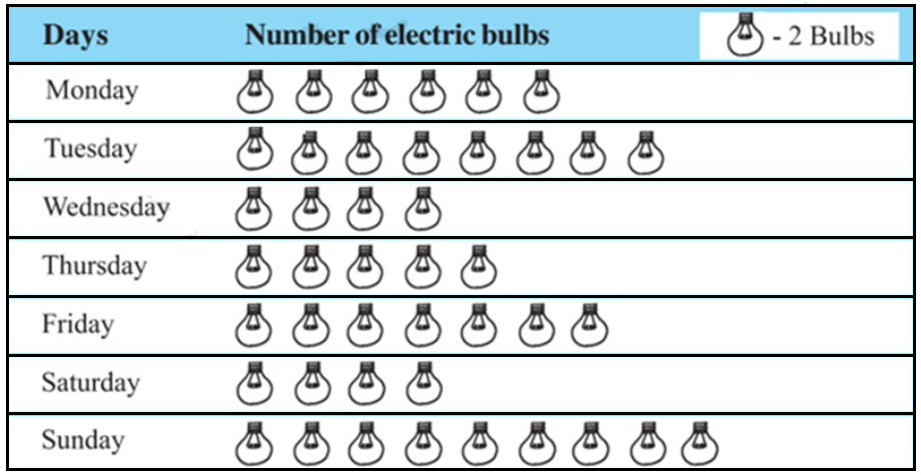
The sale of electric bulbs on different days of a week is shown below:

Observe the pictograph and answer the following questions:
  1. How many bulbs were on Friday?
  2. On which day maximum number of bulbs were sold?
  3. If one bulb was sold at the rate of Rs 10, what was the total earning on sunday?
  4. Can you find out the total earning of the week?
  5. If one big carton can hold 9 bulbs. How many cartons were needed in the given week, more than 7, more than 8 or more than 9?
If we want to show the fractions $\frac{3}{10}, \frac{9}{20}, \frac{19}{40}$ on the number line, how big should the unit be?
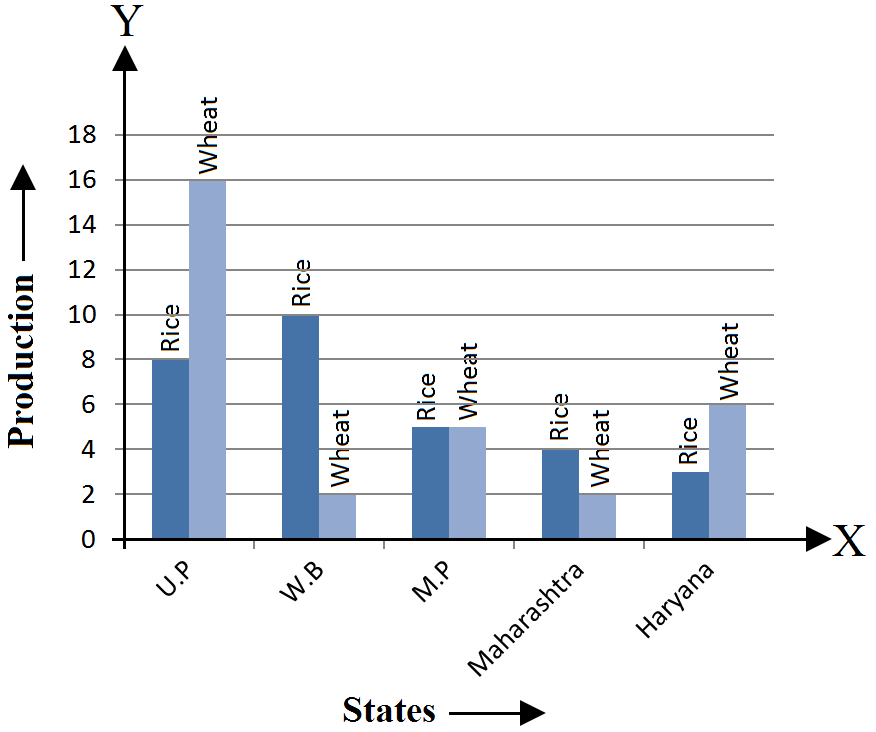
Read the following bar group and answer the following questions:
  1. What information is given by the bar group?
  2. Which state is the largest producer of rice?
  3. What state is the largest producer of wheat?
  4. Which state has total production of rice and wheat as its maximum?
  5. Which state has the total production of wheat and eice minimum?
Match the following columns on whole numbers:
S.No.
Column A
S.No.
Column B
(a)
137 + 63 = 63 + 137
(i)
Associativity of multiplication
(b)
(16 × 25) is a number
(ii)
Commutativity of multiplication
(c)
365 × 18 = 18 × 365
(iii)
Distributive law of multiplication over addition.
(d)
(d) (86 × 14) × 25 = 86 × (14 × 25)
(iv)
Commutativity of addition
(e)
23 × (80 + 5) = (23 × 80) + (23 × 5)
(v)
Closure property for multiplication
Draw an angle of 45°, using a pair of compasses.
The number of students of Std 6th and Std 7th who went to visit the Tadoba Tiger Project at Chandrapur was 140 and 196 respectively. The students of each class are to be divided into groups of the same number of students. Each group can have a paid guide. What is the maximum number of students that can be there in each group? Why do you think each group should have the maximum possible number of students?
The circumferences of four wheels are 50cm, 60cm, 75cm and 100cm. They start moving simultaneously. what least distance should they cover so that each wheel makes a complete number of revolutions?
Using a protractor, draw an angle of measure 72°. With this angle as given, draw angles of measure 36° and 54°.
Round off each of the following numbers to nearest tens, hundreds and thousands:
  1. 964
  2. 1049
  3. 45,634
  4. 79,085