MCQ
Identify correct stability order of resonating structures ?
- A
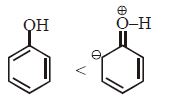
- ✓
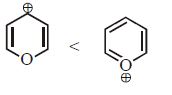
- C
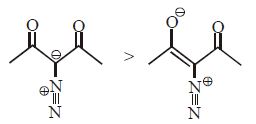
- D
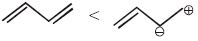
Generate a complete, print-ready paper with questions like this in minutes — across 16+ boards, with answer keys.
$\left[\Lambda_{\mathrm{m}}=\right.$ molar conductivity
$\Lambda_{\mathrm{m}}^{\circ}=$ limiting molar conductivity
$\mathrm{c}=$ molar concentration
$\mathrm{K}_{\mathrm{a}}=$ dissociation constant of $\mathrm{HX}$ ]
$C{H_3} - C \equiv CH\xrightarrow[{Dry\,ether}]{{C{H_3}MgBr}}C{H_4} + (A)\xrightarrow[{(ii)\,{H_2}O/{H^ + }}]{{(ii)\,C{O_2}}}(B),(B)$ will be
| Column $I$ | Column $II$ |
| $(A)$ Freezing of water at $273 K$ and $1 \ atm$ | $(P)$ $q =0$ |
| $(B)$ Expansion of $1 \ mol$ of an ideal gas into a vacuum under isolated conditions | $(Q)$ $w=0$ |
| $(C)$ Mixing of equal volumes of two ideal gases at constant temperature and pressure in an isolated container | $(R)$ $\Delta S _{\text {sy5 }} < 0$ |
| $(D)$ Reversible heating of $H _2( g )$ at $1 \ atm$ from $300 \ K$ to $600 \ K$, followed by reversible cooling to $300 \ K$ at $1 \ atm$ | $(S)$ $\Delta U =0$ |
| $(T)$ $\Delta G =0$ |
$(a)$ It has rotten egg like small
$(b)$ In aquous solution and presence of light it yields white phosphorous and hydrogen
$(c)$ It explodes with $Br_2$
$(d)$ In pure form it is non inflammable