MCQ
Identify following part $A$ and $B$ from the given diagram.
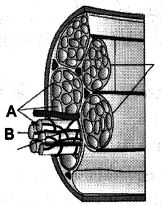
  • Muscle fibre and sarcolemma
  • B
    Sarcolemma and blood capillary
  • C
    Blood capillary and fascicle
  • D
    Sarcolemma and blood capillary

Answer

Correct option: A.
Muscle fibre and sarcolemma
a

Need a full question paper?

Generate a complete, print-ready paper with questions like this in minutes — across 16+ boards, with answer keys.

Start Generating Free

Similar questions

If a person is suffering from severe male infertility due to very few sperms (oligozoospermia) or even no live sperms (azoospermia) in the ejaculate, it can be overcome by ________. This should offer couples an alternative to using donor sperm
Pheretima is
Human beings are
Transplantation of tissues/organs fails often due to non­acceptance by the patient’s body. Which type of immune response is responsible for such rejections?
During muscular contraction which of the following events occur?

$(a)$ $'H'$ zone disappears

$(b)$ $'A'$ band widens

$(c)$ $'I'$ band reduces in width

$(d)$ Myosine hydrolyzes $ATP,$ releasing the $ADP$ and $\mathrm{Pi}$

$(e)$ $Z-$lines attached to actins are pulled inwards Choose the correct answer from the options given below.

Lactational amenorrhea prevents
Which of the following sequences is correct to initiate expiration ?
(i) Relaxation of external intercostals muscles and return of diaphragm and sternum to their normal position.
(ii) Air expelled from lungs.
(iii) Volume of thorax decreases.
(iv) Intrapulmonary pressure increases.
The pituitary gland is located in a bony cavity called ...$A$... and is attached to ...$B$... by a stalk.

Identify $A$ and $B$ to complete the given statement

If a man who is colour blind marries a women, who is pure normal for colour vision, the chances of their sons have colour blindness is
Which of the following statements are correct for regulation of cardiac activity ?
(i) A special neural centre in the medulla oblongata can moderate the cardiac function through autonomic nervous system.
(ii) Neural signals through the sympathetic nerves can increase the rate of heart beat, the strength of ventricular contraction and thereby the cardiac output.
(iii) Parasympathetic neural signals decrease the rate of heart beat, speed of conduction of action potential and thereby the cardiac output.
(iv) Adrenal medullary hormones can also increase the cardiac output.
(v) Adrenalin or epinephrine increase heart beat.
(vi) Acetylcholine decrease heart beat.