MCQ
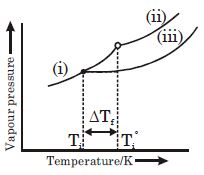
Identify $(i), (ii)$ and $(iii)$ in the following diagram :-
  • A
    $(i)$ Solution $(ii)$ Frozen solvent $(iii)$ Liquid solvent
  • B
    $(i)$ Frozen solvent $(ii)$ Solution $(iii)$ Liquid solvent
  • $(i)$ Frozen solvent $(ii)$ Liquid solvent $(iii)$ Solution
  • D
    $(i)$ Solution $(ii)$ Liquid solvent $(iii)$ Frozen solvent
Answer

Correct option: C.
$(i)$ Frozen solvent $(ii)$ Liquid solvent $(iii)$ Solution
c

Need a full question paper?

Generate a complete, print-ready paper with questions like this in minutes — across 16+ boards, with answer keys.

Start Generating Free

Similar questions

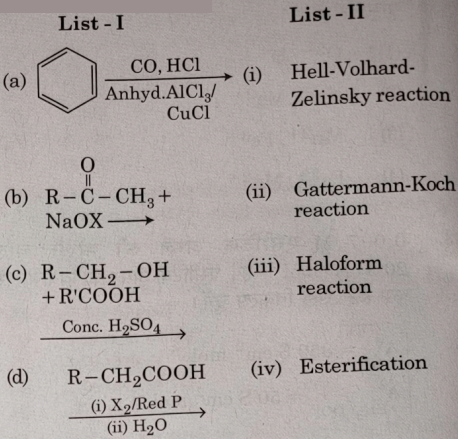
Which of the following pair is differentiated by iodoform test ?
Match List $I$ with List $II$

LIST $-I$

(Cell)

LIST $-II$

(Use/Property/Reaction)

$A$ Leclanche

cell

$I$ Converts energy of combustion into electrical energy
$B$ Ni-Cd cell $II$ Does not involve any ion in solution and is used in hearing aids
$C$ Fuel cell $III$ Rechargeable

$D$ Mercury cell

$IV$ Reaction at anode

$\mathrm{Zn} \rightarrow \mathrm{Zn}^{2+}+2 \mathrm{e}^{-}$

Choose the correct answer from the options given below:

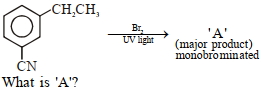
For the given reaction

${image}$

Highest oxidation state of manganese in fluoride is +4 (MnF4) but highest oxidation state in oxides is +7 (Mn2O7) because ____________.
Which of the following has maximum melting point
Which of the following exhibits highest molar conductivity
The basicity of orthophosphoric acid is
$\begin{matrix}
   O\,\,\,\,\,\,\,\,\,\,\,\,\,\,\,\,\,\,\,\,\,\,\,\,\,\,\,\,\,\,\,\,\,\,\,\,\,\,\,\,\,\,\,\,\,\,\,\,\,\,\,\,\,\,\,\,\,\,\,\,\,\,\,\,\,\,\,\,\,\,\,\,\,\,\,\,\,\,\,\,\,\,\,  \\
   ||\,\,\,\,\,\,\,\,\,\,\,\,\,\,\,\,\,\,\,\,\,\,\,\,\,\,\,\,\,\,\,\,\,\,\,\,\,\,\,\,\,\,\,\,\,\,\,\,\,\,\,\,\,\,\,\,\,\,\,\,\,\,\,\,\,\,\,\,\,\,\,\,\,\,\,\,\,\,\,\,\,\,\,\,\,  \\
   Ph-C-C{{H}_{3}}\xrightarrow[HCl]{NaN{{O}_{2}}}(A)\xrightarrow[heat]{A{{C}_{2}}O}(B)\xrightarrow{{{H}_{3}}{{O}^{+}}}(C)  \\
\end{matrix}$

Product $(C)$ of the above reaction is

In osmosis reaction, the volume of solution