MCQ
Identify most acidic hydrogen in given compound.
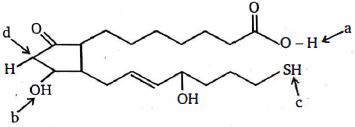
- ✓$a$
- B$b$
- C$c$
- D$d$

Generate a complete, print-ready paper with questions like this in minutes — across 16+ boards, with answer keys.
|
List-$I$ Reaction |
List-$II$ Type of redox reaction |
| $(A)$ $\mathrm{N}_{2(\mathrm{~g})}+\mathrm{O}_{2(\mathrm{~g})} \rightarrow 2 \mathrm{NO}_{(\mathrm{g})}$ | $(I)$ Decomposition |
| $(B)$ $\begin{aligned} & 2 \mathrm{~Pb}\left(\mathrm{NO}_3\right)_{2(\mathrm{~s})} \rightarrow 2 \mathrm{PbO}_{(\mathrm{s})}+4 \mathrm{NO}_{2(\mathrm{~g})}+\mathrm{O}_{2(\mathrm{~g})}\end{aligned}$ | $(II)$ Displacement |
| $(C)$ $\begin{aligned} 2 \mathrm{Na}_{(\mathrm{s})}+2 \mathrm{H}_2 \mathrm{O}_{(\mathrm{l})} \rightarrow 2 \mathrm{NaOH}_{(\mathrm{aq} .)}+\mathrm{H}_{2(\mathrm{~g})}\end{aligned}$ | $(III)$ Disproportionation |
| $(D)$ $\begin{aligned} 2 \mathrm{NO}_{2(\mathrm{~g})}+2-\mathrm{OH}_{(\mathrm{aq})} \rightarrow \mathrm{NO}_{2(\mathrm{aq} .)}^{-}+\mathrm{NO}_{3(\mathrm{qq} .)}^{-}+\mathrm{H}_2 \mathrm{O}_{(\mathrm{l})}\end{aligned}$ | $(IV)$ Combination |
Choose the correct answer from the options given below:
Sucrose $+$ $H _{2} O \rightleftharpoons$ Glucose $+$ Fructose
If the equilibrium constant $\left( K _{c}\right)$ is $2 \times 10^{13}$ at $300\, K$, the value of $\Delta_{ r } G^{\Theta}$ at the same temperature will be:
$(A)\, n = 5, m_l= + 1$
$(B)\, n =2, l =1, m_l= -1, m_s = -1/2$
The maximum number of electron$(s)$ in an atom that can have the quantum numbers as given in $(A)$ and $(B)$ are respectively