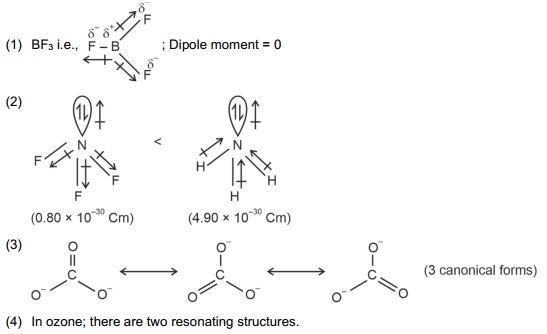
- A$\mathrm{BF}_3$ has non-zero dipole moment
- BDipole moment of $\mathrm{NF}_3$ is greater than that of $\mathrm{NH}_3$
- ✓Three canonical forms can be drawn for $\mathrm{CO}_3^{2-}$ ion
- DThree resonance structures can be drawn for ozone

Generate a complete, print-ready paper with questions like this in minutes — across 16+ boards, with answer keys.
(First dissociation constant of $H _{2} CO _{3}=4.0 \times 10^{-7}$$\log 2=0.3 ;$ density of the soft $\left.\operatorname{drink}=1\, g\, mL ^{-1}\right)$

Benzene $(C_6H_6)$ $+\,C{{H}_{3}}-CH=C{{H}_{2}}\,\xrightarrow{{{H}^{\oplus }}}A\xrightarrow{{{O}_{2}}}B$ $\xrightarrow{{{H}^{\oplus }}\,/\,\Delta }C+$$\begin{matrix}
O \\
|| \\
C{{H}_{3}}-C-C{{H}_{3}} \\
\end{matrix}$
The structure of intermediate compound $'B'$ will be
Statement I : $\left[\mathrm{Co}\left(\mathrm{NH}_3\right)_6\right]^{3+}$ is a homoleptic complex whereas $\left[\mathrm{Co}\left(\mathrm{NH}_3\right)_4 \mathrm{Cl}_2\right]^{+}$is a heteroleptic complex.
Statement II : Complex $\left[\mathrm{Co}\left(\mathrm{NH}_3\right)_6\right]^{3+}$ has only one kind of ligands but $\left[\mathrm{Co}\left(\mathrm{NH}_3\right)_4 \mathrm{Cl}_2\right]^{+}$has more than one kind of ligands.
In the light of the above statements, choose the correct answer from the options given below.