MCQ
Identify the correct order
  • A
    $sec^{-1}(-2) < sec^{-1}(-1) < sec^{-1}(1) < sec^{-1}(2)$
  • B
    $sec^{-1}(2) < sec^{-1}(1) < sec^{-1}(-1) < sec^{-1}(-2)$
  • C
    $sec^{-1}(1) < sec^{-1}(-1) < sec^{-1}(2) < sec^{-1}(-2)$
  • $sec^{-1}(1) < sec^{-1}(2) < sec^{-1}(-2) < sec^{-1}(-1)$

Answer

Correct option: D.
$sec^{-1}(1) < sec^{-1}(2) < sec^{-1}(-2) < sec^{-1}(-1)$
d
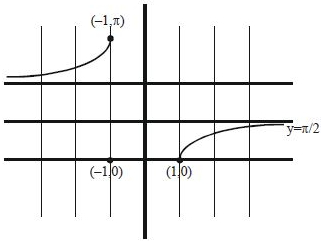
abvious from figure

$\sec ^{-1}(1)<\sec ^{-1}(2)<\sec ^{-1}(-2)<\sec ^{-1}(-1)$

Need a full question paper?

Generate a complete, print-ready paper with questions like this in minutes — across 16+ boards, with answer keys.

Start Generating Free

Similar questions

If $A$ is a $3 \times 3$ matrix such that $|A|=8$, then $|3 A|$ equals
If $a,b,c$ are different and $\left| {\,\begin{array}{*{20}{c}}a&{{a^2}}&{{a^3} - 1}\\b&{{b^2}}&{{b^3} - 1}\\c&{{c^2}}&{{c^3} - 1}\end{array}\,} \right| = 0$, then
Choose the correct answer from the given four option.
The general solution of $\text{e}^{\text{x}}\cos\text{ydx}-\text{e}^\text{x}\sin\text{ydy}=0$ is:
  1. $\text{e}^{\text{x}}\cos\text{y}=\text{k}$
  2. $\text{e}^{\text{x}}\sin\text{y}=\text{k}$
  3. $\text{e}^{\text{x}}=\text{k}\cos\text{y}$
  4. $\text{e}^{\text{x}}=\text{k}\sin\text{y}$
For any positive integer $n$, let $S_n:(0, \infty) \rightarrow R$ be defined by

$S_n(x)=\sum_{k=1}^n \cot ^{-1}\left(\frac{1+k(k+1) x^2}{x}\right)$

where for any $x \in R , \cot ^{-1} x \in(0, \pi)$ and $\tan ^{-1}(x) \in\left(-\frac{\pi}{2}, \frac{\pi}{2}\right)$. Then which of the following

statements is (are) $TRUE$?

$(A)$ $S _{10}( x )=\frac{\pi}{2}-\tan ^{-1}\left(\frac{1+11 x ^2}{10 x }\right)$, for all $x >0$

$(B)$ $\lim _{n \rightarrow \infty} \cot \left(S_n(x)\right)=x$, for all $x>0$

$(C)$ The equation $S_3(x)=\frac{\pi}{4}$ has a root in $(0, \infty)$

$(D)$ $\tan \left( S _{ n }( x )\right) \leq \frac{1}{2}$, for all $n \geq 1$ and $x >0$
What is the value of $ \sin-1(\sin 6)?$
  1. -2π - 6
  2. 2π + 6
  3. either -2π + 6 or 2π + 6
  4. 2π - 6
If $y=\sin x^{\circ}$ then the value of $\frac{d y}{d x}$ is
A coin is tossed three times. If events A and B are defined as A = Two heads come, B = Last should be head, Then, A and B are
  1. Independent.
  2. Dependent.
  3. Both.
  4. Mutually exclusive.
Mark the correct alternative in the following question:
Suppose a random variable X follows the binomial distribution with parameters n and p, where 0 < p < 1. If $\frac{\text{P(X = r})}{\text{P(X = n} -\text{r})}$ is independent of n and r, then p equals:
  1. $\frac{1}{2}$
  2. $\frac{1}{3}$
  3. $\frac{1}{5}$
  4. $\frac{1}{7}$
If $\theta$ is the angle between any two vectors $\vec{\text{a}}$ and $\vec{\text{b}},$ then $\big|\vec{\text{a}}.\vec{\text{b}}\big|=\big|\vec{\text{a}}\times\vec{\text{b}}\big|$ when $\theta$ is equal to:
  1. $0$
  2. $\frac{\pi}{4}$
  3. $\frac{\pi}{2}$
  4. $\pi$
Let $f : [0,1] \to [0,1]$ be a continuous function, then the equation $f(x) = x$