MCQ
  • A
    A-(ii), B-(i), C-(iv), D-(iii)
  • A-(iii), B-(i), C-(iv), D-(ii)
  • C
    A-(iv), B(ii), C-(i), D-(iii)
  • D
    A-(iv), B-(i), C-(iii), D-(ii)

Answer

Correct option: B.
A-(iii), B-(i), C-(iv), D-(ii)
(b)

Need a full question paper?

Generate a complete, print-ready paper with questions like this in minutes — across 16+ boards, with answer keys.

Start Generating Free

Similar questions

When the total fixed cost of producing $100 $ units is $₹ 30$ and the average variable cost is $₹ 3$, total cost is: $($Choose the correct alternative$)$
Image

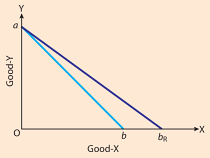
On the basis of the above diagram, what does the shifting of budget line from ab to ab, indicate?
The consumer is in equilibrium and is consuming commodity-X only. The marginal utility from last unit consumed of commodity X = 50 utils and $MU _{ M }=10$.Find the price of the commodity-X.
Assume that when price is $20$, the quantity demanded is $15$ units and when price is $18$, the quantity demanded is $16$ units. Based on this information what is the marginal revenue resulting from an increase in output from $15$ units to $16$ units?
Increase or decrease in supply means:
Given the fact that MRS between goods X and Y is diminishing, IC is:
According to economic growth, Production Possibility Curve will show $.........$
If a firm's supply increases due to application of improved technology, this is known as: Hint: If the supply of a commodity increases due to other factors than its price, it is called 'increase in supply'. Causes of increase in supply are improvement in technology, increase in price of its complementary goods, decrease in taxation, decrease in price of its substitute goods, etc.
Which of the following shows relationship between the price of a commodity and quantity supplied graphically?
The opportunity cost of 100 kg of rice produced on a land which can also produce 80 tonnes of wheat is: