MCQ
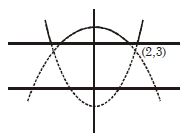
Identify the correct statement about function $f(x) = max(x^2 -1, 7 -x^2, 5)$
  • $f(x)$ is not differentiable at $4$ points
  • B
     range of $f(x)$ is $\left[ {3,\infty } \right)$
  • C
    $f(x)$ is an injective function
  • D
    $f(x)$ is discontinuous at $4$ points.

Answer

Correct option: A.
$f(x)$ is not differentiable at $4$ points
a

Need a full question paper?

Generate a complete, print-ready paper with questions like this in minutes — across 16+ boards, with answer keys.

Start Generating Free

Similar questions

The value of $\int\limits_{0}^{2 \pi} \frac{x \sin ^{8} x}{\sin ^{8} x+\cos ^{8} x} d x$ is equal to
The value of $‘a’$  in order that $f(x) = \sqrt 3 $ $\sin x - \cos x - 2ax + b$ decreases for all real values of  $x$, is given by
If $C$ and $D$ are two events such that $P\left( D \right) \ne 0$ then the correct statement among the following is
If $\text{f(x)}=\frac{1-\sin\text{x}}{(\pi-2\text{x})^2},$ when $\text{x}\neq\frac{\pi}{2}=\lambda$ then $f(x)$ will be continuous function at $\text{x}=\frac{\pi}{2},$ where $\lambda=$
Function $f(x) = {{\lambda \sin x + 6\cos x} \over {2\sin x + 3\cos x}}$ is monotonic increasing, if
If $O$ is the origin and $OP = 3$ with direction ratios $ - 1,\,2, - 2$, then co-ordinates of $P$ are
${d \over {dx}}\log \tan \left( {{\pi \over 4} + {x \over 2}} \right) = $
The area of the region bounded by the parabola $(y-2)^{2}=(x-1)$, the tangent to it at the point whose ordinate is $3$ and the $\mathrm{x}$-axis is :
Let $\Omega$ be the set of all $3 \times 3$ symmetric matrices all of whose entries are either $0$ or $1$ . Five of these entries are $1$ and four of them are $0$ .

$1.$ The number of matrices in $\Omega$ is

$(A)$ $12$ $(B)$ $6$ $(C)$ $9$ $(D)$ $3$

$2.$ The number of matrices $A$ in $\Omega$ for which the system of linear equations

$A\left[\begin{array}{l}x \\ y \\ z\end{array}\right]=\left[\begin{array}{l}1 \\ 0 \\ 0\end{array}\right]$ has a unique solution, is

$(A)$ less than $4$

$(B)$ at least $4$ but less than $7$

$(C)$ at least $7$ but less than $10$

$(D)$ at least $10$

$3.$ The number of matrices $A$ in $\Omega$ for which the system of linear equations

$A\left[\begin{array}{l}x \\ y \\ z\end{array}\right]=\left[\begin{array}{l}1 \\ 0 \\ 0\end{array}\right]$ is inconsistent, is

$(A)$ $0$ $(B)$ more than $2$ $(C)$ $2$ $(D)$ $1$
Let g(x) = 1 + x - [x] and $\text{f(x)}=\begin{cases}-1,&\text{x}<0\\0,&\text{x}=0\\1,&\text{x}>0\end{cases}$ where [x] denotes the greatest integer less than or equal to x. Then for all x, f(g(x)) is equal to: