MCQ
Identify the correct statement about the magnetic field lines:
- AThese start from the N-pole and terminate on the S-pole.
- BThese lines always form closed loops.
- CBoth (a) and (b) are correct.
- DBoth (a) and (b) are wrong.
Explanation:
The magnetic field lines of a simple magnet are shown in the picture below.They point from the north pole to the south pole. However, the magnetic field lines do not just end at the tip of the magnet. They go right through it, so that inside the magnet the magnetic field points from the south pole to the north pole.
Magnetic field lines form closed loops since magnetic monopoles doesn't exist unlike an electric charge.
Generate a complete, print-ready paper with questions like this in minutes — across 16+ boards, with answer keys.
In a Young's double slit experiment the source S and the two slits A and B are vertical with slit A above slit B. The fringes are observed on a vertical screen K. The optical path length from S to B is increased very slightly (by introducing a transparent material of higher refractive index) and the optical path length from S to A is not changed, as a result the fringe system on K moves
|
(a) Vertically downwards slightly |
(b) Vertically upwards slightly |
|
(c) Horizontally, slightly to the left |
(d) Horizontally, slightly to the right |
Self induction of a solenoid is
|
(a) Directly proportional to current flowing through the coil |
|
(b) Directly proportional to its length |
|
(c) Directly proportional to area of cross-section |
|
(d) Inversely proportional to area of cross-section |
When light travels from one medium to the other of which the refractive index is different, then which of the following will change
|
(a) Frequency, wavelength and velocity |
(b) Frequency and wavelength |
|
(c) Frequency and velocity |
(d) Wavelength and velocity |
The charge on a capacitor of capacitance 10 μF connected as shown in the figure is
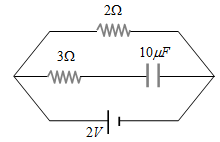
|
(a) 20 μC |
(b) 15 μC |
(c) 10 μC |
(d) Zero |
Assertion : For the scattering of a-particles at a large angles, only the nucleus of the atom is responsible.
Reason : Nucleus is very heavy in comparison to electrons.
|
(a) If both assertion and reason are true and the reason is the correct explanation of the assertion. |
|
(b) If both assertion and reason are true but reason is not the correct explanation of the assertion. |
|
(c) If assertion is true but reason is false. |
|
(d) If the assertion and reason both are false. |
Two identical coaxial circular loops carry current i each circulating in the clockwise direction. If the loops are approaching each other, then
|
(a) Current in each loop increases |
|
(b) Current in each loop remains the same |
|
(c) Current in each loop decreases |
|
(d) Current in one-loop increases and in the other it decreases |