MCQ
Identify the correct statement
  • A
    Corrosion of iron can be minimized by forming a contact with another metal with a higher reduction potential
  • B
    Iron corrodes in oxygen free water
  • Corrosion of iron can be minimized by forming an impermeable barrier at its surface
  • D
    Iron corrodes more rapidly in salt water because its electrochemical potential is higher
Answer

Correct option: C.
Corrosion of iron can be minimized by forming an impermeable barrier at its surface
c
Corrosion of iron can be minimized by forming an impermeable barrier at its surface

Need a full question paper?

Generate a complete, print-ready paper with questions like this in minutes — across 16+ boards, with answer keys.

Start Generating Free

Similar questions

A tribasic acid is
Correct formula of potassium ferrocyanide is
Tollen's reagent is
Which of the following will give yellow precipitate with ${I_2}/NaOH$
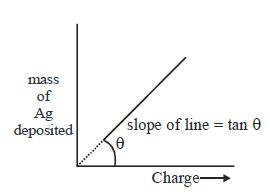
In the electrolysis of $AgNO_3$, the mass of $Ag$ deposited is plotted against the charge Slope of the line gives
$2\, moles$ each of liquids $A$ and $B$ are dissolved to form an ideal solution. What will be the mole fraction of $B$ in the vapour phase? Given : $P_A^o = 120\, torr, P_B^o = 80\, torr$
Which of the following is correct
For the given reaction

$\begin{array}{*{20}{c}}
  {{\,\,R_1}} \\ 
  | \\ 
  {R - C - X} \\ 
  | \\ 
  {{\,\,R_2}} 
\end{array}\xrightarrow{{HOH}}\begin{array}{*{20}{c}}
  {{\,\,R_1}\,\,\,\,} \\ 
  {|\,\,\,\,} \\ 
  {R - C - OH} \\ 
  {|\,\,\,\,\,} \\ 
  {{\,\,R_2}\,\,\,\,} 
\end{array}$

Which substrate will give maximum racemisation ?

Combination of which parameter explain more oxidising strength of $F_2$ as compared to $Cl_2$ in water:
Match the reactions (in the given stoichiometry of the reactants) in List-$I$ with one of their products given in List-$II$ and choose the correct option.

List-$I$ List-$II$
$\mathrm{P}_2 \mathrm{O}_3+3 \mathrm{H}_2 \mathrm{O} \rightarrow$ $\mathrm{P}(\mathrm{O})\left(\mathrm{OCH}_3\right) \mathrm{Cl}_2$
$\mathrm{P}_4+3 \mathrm{NaOH}+3 \mathrm{H}_2 \mathrm{O} \rightarrow$ $\mathrm{H}_3 \mathrm{PO}_3$
$\mathrm{PCl}_5+\mathrm{CH}_3 \mathrm{COOH} \rightarrow$ $\mathrm{PH}_3$
$\mathrm{H}_3 \mathrm{PO}_2+2 \mathrm{H}_2 \mathrm{O}+4 \mathrm{AgNO}_3 \rightarrow$ $\mathrm{H}_3 \mathrm{PO}_4$