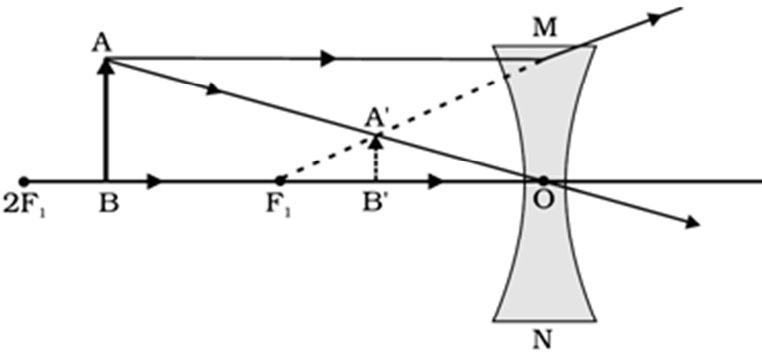
Identify the device used as a spherical mirror or lens in following cases, when the image formed is virtual and erect in each case.Object is placed between infinity and device, image formed is diminished and between focus and optical centre on the same side as that of the object.
Download our app for free and get started
Concave lens is used.

Download our appand get started for free
Experience the future of education. Simply download our apps or reach out to us for more information. Let's shape the future of learning together!No signup needed.*
Similar Questions
- 1View SolutionIt is desired to obtain an erect image of an object, using concave mirror of focal length of 12cm.
Where will the image of this object be, if it is placed 24cm in front of the mirror? Draw ray diagram for this situation also to justify your answer.
Show the positions of pole, principal focus and the centre of curvature in the above ray diagrams. - 2View SolutionList some things that concave lens and convex mirror have in common.
- 3View SolutionAn object is placed at a distance of 30cm in front of a convex mirror of focal length 15cm. Write four characteristics of the image formed by the mirror.
- 4View SolutionWhich kind of mirrors are used in the headlights of a motorcar and why?
- 5View SolutionA doctor has prescribed a corrective lens of power, -1.5D. Find the focal length of the lens. Is the prescribed lens diverging or converging?
- 6View SolutionDraw ray diagrams showing the image formation by a concave mirror when an object is placed:A little beyond centre of curvature of the mirror.
- 7View SolutionThe following table gives the refractive indices of a few media,
Use this table to give an example of:12345Medium:WaterCrown glassRock saltRubyDiamondRefractive index:1.331.521.541.712.42- A medium pair so that light speeds up when it goes from one of these medium to another.
- A medium pair so that light slows down when it goes from one of these medium to another.
- 8View SolutionDefine:
- Principal focus of a concave mirror.
- Focal length of a concave mirror.
- 9View SolutionThe boy walks towards the mirror at a speed of 1m/ s. At what speed does his image approach him?
- 10View SolutionState two positions in which a concave mirror produces a magnified image of a given object. List two differences between the two images.