MCQ
Identify the dimensional formula of electric current.
  • A
    $\left[M L T^{-2}\right]$
  • $\left[ M ^0 L^0 T^0 A^1\right]$
  • C
    $\left[ M L ^3 T^0\right]$
  • D
    $\left[ M L ^2 T^{-3}\right]$

Answer

Correct option: B.
$\left[ M ^0 L^0 T^0 A^1\right]$
The flow of charge per unit time is defined as current. The fundamental unit of current is Ampere $($named after Andre Marie Ampere$).$

Need a full question paper?

Generate a complete, print-ready paper with questions like this in minutes — across 16+ boards, with answer keys.

Start Generating Free

Similar questions

At a point on the surface of the earth, the value of the horizontal component of earth's magnetic field is equal to value of vertical magnetic component of earths magnetic field the angle of dip is
Given a point source of light, which of the following can produce a parallel beam of light
An astronomical refracting telescope has an objective of focal length $20\,m$ and an eye piece of focal length $2\,cm$, then
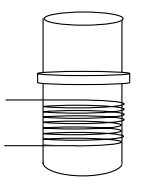
$STATEMENT-1$  A vertical iron rod has a coil of wire wound over it at the bottom end. An alternating current flows in the coil. The rod goes through a conducting ring as shown in the figure. The ring can float at a certain height above the coil. Because

$STATEMENT- 2$ In the above situation, a current is induced in the ring which interacts with the horizontal component of the magnetic field to produce an average force in the upward direction.
Nuclear fusion is common to the pair
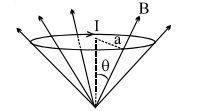
A circular current loop of radius a is placed in a radial field $B$ as shown. The net force acting on the loop is
Let $T_a$ and $T_b$ be the final temperatures of the samples $A$ and $B$, respectively, in the previous question.
The inward and outward electric flux for a closed surface in units of $N-m^2/C$ are respectively $8\times10^3$ and $4\times10^3$ Then the total charge inside the surface is [where $\varepsilon_0$ = permittivity constant]
Which of the following figure represents the variation of In $\left(\frac{R}{R_{0}}\right)$ with $\ln A$ (If $R=$ radius of a nucleus and $A =$ its mass number)
It takes $12$ minutes to boil $1$ litre of water in an electric kettle. Due to some defect it becomes necessary to remove $20 \%$ turns of heating coil of the kettle. After repair, how much time will it take to boil $1$ litre of water.