Question
Identify the electromagnetic waves whose wavelengths vary as
  1. 10–12 m < $\lambda$ < 10–8 m
  2. 10–3 m < $\lambda$ < 10–1 m
Write one use for each.

Answer

  1. X – rays

Used for medical purposes.

  1. Microwaves

Used in radar systems.

Need a full question paper?

Generate a complete, print-ready paper with questions like this in minutes — across 16+ boards, with answer keys.
Start Generating Free

Similar questions

Rain is falling vertically. A man running on the road keeps his umbrella tilted but a man standing on the street keeps his umbrella vertical to protect himself from the rain. But both of them keep their umbrella vertical to avoid the vertical sun-rays. Explain.
Sketch the magnetic field lines for a current-carrying circular loop near its centre. Replace the loop by an equivalent magnetic dipole and sketch the magnetic field lines near the centre of the dipole. Identify the difference.
Two convex lenses of same focal length but of aperture A1 and A2 (A2 < A1), are used as the objective lenses in two astronomical telescopes having identical eyepieces. What is the ratio of their resolving power? Which telescope will you prefer and why? Give reason.
Answer the following questions:
  1. Optical and radio telescopes are built on the ground while X-ray astronomy is possible only from satellites orbiting the Earth. Why?
  2. The small ozone layer on top of the stratosphere is crucial for human survival. Why ?
No interference pattern is detected when two coherent sources are infinitely close to each other. Why?
Compare the direction of the magnetic field inside a solenoid with that of the field there if the solenoid is replaced by its equivalent combination of north pole and south pole.
What is reflection of light? Define angle of incidence and angle of reflection.
The radius of a spherical conductor shell is $R$ and the charge on it is $Q$. Compare the potential at a distance 2 R from the centre of the sphere with the potential at a distance $R / 2$.
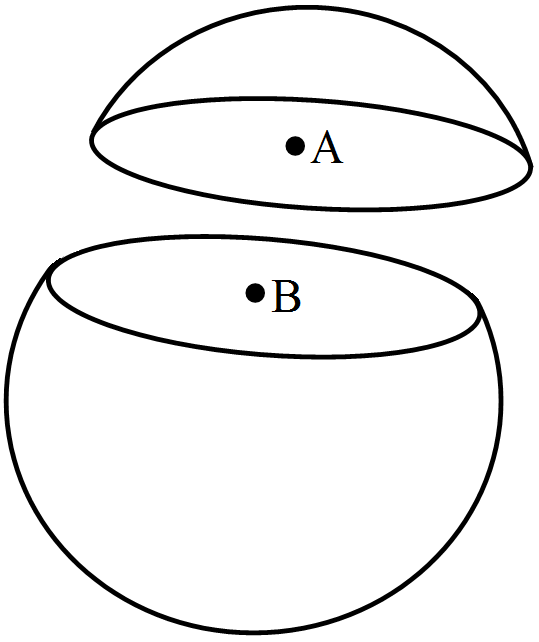
A thin spherical shell having uniform density is cut in two parts by a plane and kept separated as shown in figure (11-E3). The point A is the centre of the plane section of the first part and B is the centre of the plane section of the second part. Show that the gravitational field at A due to the first part is equal in magnitude to the gravitational field at B due to the second part.

A simple microscope is rated 5 for a normal relaxed eye. What will be its magnifying power for a relaxed farsighted eye whose near point is 40cm?