MCQ
Identify the factor which does not depend on the resistance of a conductor.
- ANature of material
- BArea of cross-section
- CLength
- DViscosity
Explanation:
The resistance of a conductor is directly proportional to its length, inversely proportional to the area of cross-section, and nature of the material. The resistance of the conductor does not depend on viscosity.
Generate a complete, print-ready paper with questions like this in minutes — across 16+ boards, with answer keys.
To make a PN junction conducting
|
(a) The value of forward bias should be more than the barrier potential |
|
(b) The value of forward bias should be less than the barrier potential |
|
(c) The value of reverse bias should be more than the barrier potential |
|
(d) The value of reverse bias should be less than the barrier potential |
In a junction diode, the holes are due to
| (a) Protons | (b) Neutrons | (c) Extra electrons | (d) Missing of electrons |
The resistance of a discharge tube is
|
(a) Ohmic |
(b) Non-ohmic |
(c) Both (a) and (b) |
(d) Zero |
According to the Rutherford’s atomic model, the electrons inside the atom are
|
(a) Stationary |
(b) Not stationary |
(c) Centralized |
(d) None of these |
In the figure, current through the 3 Ω resistor is 0.8 ampere, then potential drop through 4 Ω resistor is
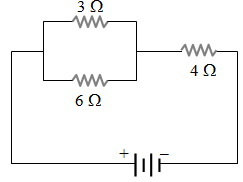
|
(a) 9.6 V |
(b) 2.6 V |
(c) 4.8 V |
(d) 1.2 V |
The equivalent resistance between points A and B of an infinite network of resistances each of 1Ω connected as shown, is

|
(a) Infinite |
(b) 2 Ω |
(c) |
(d) Zero |
A convex lens makes a real image 4 cm long on a screen. When the lens is shifted to a new position without disturbing the object, we again get a real image on the screen which is 16 cm tall. The length of the object must be
|
(a) 1/4 cm |
(b) 8 cm |
(c) 12 cm |
(d) 20 cm |
