MCQ
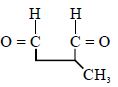
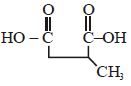
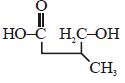
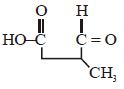
Identify the final product $(B)$.
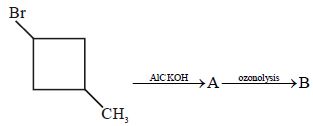
  • B

  • C

  • D

Answer

Correct option: A.

a

Need a full question paper?

Generate a complete, print-ready paper with questions like this in minutes — across 16+ boards, with answer keys.

Start Generating Free

Similar questions

Copper reduces $NO _{3}^{-}$ into $NO$ and $NO _{2}$ depending uponthe concentration of $HNO _{3}$ insolution. (Assuming fixed $\left[ Cu ^{2+}\right]$ and $\left. P _{ NO }= P _{ NO _{2}}\right),$ the $HNO _{3}$ concentration at which the thermodynamic tendency for reduction of $NO _{3}^{-}$ into $NO$ and $NO _{2}$ by copper is same is $10^{ x }\, M$. The value of $2 x$ is ...... .

$\left[\right.$ Given $, E_{C u^{2+} / C u}^{o}=0.34\, V , E _{ NO _{3}^{-} / NO_2 }^{\circ}=0.96\, V$ (Rounded-off to the nearest integer) $E _{ NO _{3} / NO _{2}}^{\circ}=0.79 \,V$ and at $298 \,K$  $\left.\frac{ RT }{ F }(2.303)=0.059\right]$

Which is correct $ IUPAC$ name of the following compound

$\begin{array}{*{20}{c}}
  {\,\,C{H_3}\,\,\,\,\,\,\,\,\,\,\,\,\,\,\,\,\,C{H_3}} \\ 
  {|\,\,\,\,\,\,\,\,\,\,\,\,\,\,\,\,\,\,\,\,\,\,\,\,\,\,\,\,\,|\,\,} \\ 
  {C{H_3} - CH - CH - CH - C{H_3}} \\ 
  {\,|\,\,\,} \\ 
  {\,\,\,\,\,\,\,\,\,\,\,\,\,\,\,\,\,\,\,\,\,\,C{H_2} - C{H_3}\,\,\,\,\,\,} 
\end{array}$

Acetone and acetaldehyde can be distinguished by
The main function of a catalyst in speeding up a reaction is
$EAN$ of $Fe$ in $[Fe(C_2O_4)_3]^{3-}$
The atomic radii in periodic table among elements from right to left
$B\xleftarrow{{NaB{H_4}}}$ $[Figure]$  $CH=CH-CHO$ $\xrightarrow{{{H_2}/Pt}}A$

$A$ and $B$ are :

Consider the following information about element $P$ and $Q$

  Period number Group number
$P$ $2$ $15$
$Q$ $3$ $2$

Then formula of the compound formed by $P$ and $Q$ element is

Hybridization of central $I$ in $I_3^-$ that is
Calculate the standard heat of formation of carbon disulphide $(l)$, given that the standard heat of combustion of carbon $(s)$, sulphur $(s)$ and carbon disulphide $(l)$ are $ - 393.3,\, - 293.72$ and $ - 1108.76\,kJ\,mo{l^{ - 1}}$ respectively ......$kJ\,mo{l^{ - 1}}$