MCQ
Identify the pair of physical quantities that have same dimensions
  • velocity gradient and decay constant
  • B
    wien's constant and Stefan constant
  • C
    angular frequency and angular momentum
  • D
    wave number and Avogadro number

Answer

Correct option: A.
velocity gradient and decay constant
a
Velocity gradient $=\frac{ dV }{ dx }=\frac{1}{ S }$

$\lambda=\frac{1}{S}$

Need a full question paper?

Generate a complete, print-ready paper with questions like this in minutes — across 16+ boards, with answer keys.
Start Generating Free

Similar questions

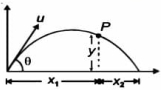
In the given figure for a projectile
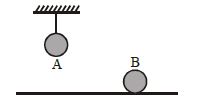
Two identical balls, $A$ and $B$ , of uniform composition and initially at the same temperature, each absorb exactly the same amount of heat. $A$ is hanging down from the ceiling while $B$ rests on the horizontal floor in the same room. Assuming no subsequent heat loss by the balls, which of the following statements is correct about their final temperatures, $T_A$ and $T_B$ , once the balls have reached their final state?
If a mixture of $28\,\, g$ of Nitrogen, $4 \,\,g$ of Hydrogen and $8 \,\,gm$ of Helium is contained in a vessel at temperature $400 \,\,K$ and pressure $8.3 \times 10^5 \,\,Pa$, the density of the mixture will be :
A vibratory motion is represented by $x = 2A\,\cos \omega t + A\,\cos \,\left( {\omega t + \frac{\pi }{2}} \right) + A\,\cos \,\left( {\omega t + \pi } \right)$ $ + \frac{A}{2}\,\cos \left( {\omega t + \frac{{3\pi }}{2}} \right)$. The resultant amplitude of the motion is
Young's modulus of elasticity of material depends upon
The relative error in the determination of the surface area of a sphere is $\alpha $. Then the relative error in the determination of its volume is
The force is given in terms of time $t$ and displacement $x$ by the equation

${F}={A} \cos {Bx}+{C} \sin {Dt}$

The dimensional formula of $\frac{{AD}}{{B}}$ is -
The radii of the two columns in $U$ tube are $r_1$ and $r_2$. When a liquid of density $\rho $ (angle of contact is $0^o$ ) is filled in it the level difference of liquid in two arms is $h$. The surface tension of liquid is ($g =$ acceleration due to gravity)
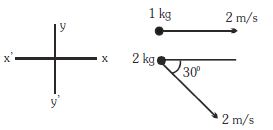
The velocity of centre of mass of the system as shown in the figure is
A light unstretchable string passing over a smooth light pulley connects two blocks of masses $m_1$ and $m_2$. If the acceleration of the system is $\frac{g}{8}$, then the ratio of the masses $\frac{\mathrm{m}_2}{\mathrm{~m}_1}$ is: