MCQ
Identify the reaction from following having top position in $EMF$ series (Std. red. potential) according to their electrode potential at $298 \;K$.
  • A
    $K ^{+}+1 e ^{-} \rightarrow K _{( s )}$
  • B
    $Mg ^{2+}+2 e ^{-} \rightarrow Mg _{( s )}$
  • C
    $Fe ^{2+}+2 e ^{-} \rightarrow Fe _{( s )}$
  • $Au ^{3+}+3 e ^{-} \rightarrow Au _{( s )}$

Answer

Correct option: D.
$Au ^{3+}+3 e ^{-} \rightarrow Au _{( s )}$
d
$\begin{array}{ll}A u^{3+}+3 e^{-} \rightarrow A u(s) & E^{0}=1.40 \vee \\ F e^{2+}+2 e^{-} \rightarrow F e(s) & E^{0}=-0.44 v \\ M g^{2+}+2 e^{-} \rightarrow M g(s) & E^{0}=-2.36 v \\ K^{+}+1 e^{-} \rightarrow K(s) & E^{0}=-2.93 V\end{array}$

As per electrochemical series, $Au ^{3+}$ occupies. the top position.

Need a full question paper?

Generate a complete, print-ready paper with questions like this in minutes — across 16+ boards, with answer keys.

Start Generating Free

Similar questions

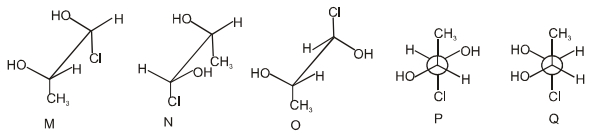
Which of the given statement$(s)$ about $N , O , P$ and $Q$ with respect to $M$ is (are) correct?.

$(A)$ $M$ and $N$ are non-mirror image stereoisomers

$(B)$ $M$ and $O$ are identical

$(C)$ $M$ and $P$ are enantiomers

$(D)$ $M$ and $Q$ are identical

The $IUPAC$  name of $\begin{matrix}
   C{{H}_{3}}-C-C-C{{H}_{3}}  \\
   ||\,\,\,\,\,\,\,\,||  \\
   O\,\,\,\,\,\,O  \\
\end{matrix}$ is
The number of $sp ^{3}$ hybridised carbons in an acyclic neutral compound with molecular formula $C _{4} H _{5} N$ is.
Which of the following sets of At. No. corresponds to element of group $16$
Compare the  $'x'$  and  $'y'$ bond lengths

$\begin{array}{*{20}{c}}
  {{\mkern 1mu} {\mkern 1mu} {\mkern 1mu} {\mkern 1mu} {\mkern 1mu} {\mkern 1mu} {\mkern 1mu} {\mkern 1mu} {\mkern 1mu} {\mkern 1mu} {\mkern 1mu} {\mkern 1mu} {\mkern 1mu} {\mkern 1mu} {\mkern 1mu} {\mkern 1mu} {\mkern 1mu} {\mkern 1mu} {\mkern 1mu} {\mkern 1mu} {\mkern 1mu} {\mkern 1mu} {\mkern 1mu} {\mkern 1mu} {\mkern 1mu} O\,\,\,\,\,\,{\mkern 1mu} {\mkern 1mu} {\mkern 1mu} {\mkern 1mu} {\mkern 1mu} O{\mkern 1mu} {\mkern 1mu} {\mkern 1mu} {\mkern 1mu} {\mkern 1mu} {\mkern 1mu} {\mkern 1mu} {\mkern 1mu} {\mkern 1mu} {\mkern 1mu} {\mkern 1mu} {\mkern 1mu} {\mkern 1mu} {\mkern 1mu} {\mkern 1mu} {\mkern 1mu} {\mkern 1mu} {\mkern 1mu} {\mkern 1mu} {\mkern 1mu} {\mkern 1mu} } \\ 
  {{\mkern 1mu} {\mkern 1mu} {\mkern 1mu} {\mkern 1mu} {\mkern 1mu} {\mkern 1mu} {\mkern 1mu} {\mkern 1mu} {\mkern 1mu} {\mkern 1mu} {\mkern 1mu} {\mkern 1mu} {\mkern 1mu} {\mkern 1mu} {\mkern 1mu} {\mkern 1mu} {\mkern 1mu} {\mkern 1mu} {\mkern 1mu} ||{\mkern 1mu} {\mkern 1mu} {\mkern 1mu} {\mkern 1mu} \,\,\,\,\,\,\,\,{\mkern 1mu} {\mkern 1mu} {\mkern 1mu} {\mkern 1mu} ||{\mkern 1mu} {\mkern 1mu} {\mkern 1mu} {\mkern 1mu} {\mkern 1mu} {\mkern 1mu} {\mkern 1mu} {\mkern 1mu} {\mkern 1mu} {\mkern 1mu} {\mkern 1mu} {\mkern 1mu} {\mkern 1mu} {\mkern 1mu} {\mkern 1mu} {\mkern 1mu} } \\ 
  {H - O - S\mathop {{\text{ }} - }\limits^x {\mkern 1mu} S - O - H} 
\end{array}$

 $\begin{array}{*{20}{c}}
  {\begin{array}{*{20}{c}}
  {\,\,\,\,\,\,\,\,\,\,\,\,\,\,\,\,\,\,\,\,\,\,\,\,\,\,\,\,\,\,\,\,\,\,\,\,\,\,\,\,\,\,\,O\,\,\,\,\,\,\,\,\,O\,\,\,\,\,} \\ 
  {\,\,\,\,\,\,\,\,\,\,\,\,\,\,\,\,\,\,\,\,\,\,\,\,\,\,\,\,\,\,\,\,\,\,\,\,\,\,\,\,||\,\,\,\,\,\,\,\,\,\,||} 
\end{array}\,\,\,\,\,\,\,\,\,\,\,\,\,\,\,\,\,\,\,\,\,\,\,\,\,\,\,\,\,\,\,\,\,\,\,\,\,\,\,\,} \\ 
  {HO - S\mathop - \limits^y S - OH} \\ 
  {\,\,\,\,\,||\,\,\,\,\,\,\,\,\,\,\,\,\,} \\ 
  {\,\,\,\,\,O\,\,\,\,\,\,\,\,\,\,\,} 
\end{array}$
The number of geometrical isomers for octahedral $[Co(NH_3)_2Cl_4]^-,$ square planar $[AuCl_2Br_2]^-$ and $[Pt(en)Cl_2]$ are
The reaction that occurs in a breath analyser, a device used to determine the alcohol level in a person's blood stream is

$2 \mathrm{~K}_{2} \mathrm{Cr}_{2} \mathrm{O}_{7}+8 \mathrm{H}_{2} \mathrm{SO}_{4}+3 \mathrm{C}_{2} \mathrm{H}_{6} \mathrm{O} \rightarrow 2 \mathrm{Cr}_{2}\left(\mathrm{SO}_{4}\right)_{3}+$

$3 \mathrm{C}_{2} \mathrm{H}_{4} \mathrm{O}_{2}+2 \mathrm{~K}_{2} \mathrm{SO}_{4}+11 \mathrm{H}_{2} \mathrm{O}$

If the rate of appearance of $\mathrm{Cr}_{2}\left(\mathrm{SO}_{4}\right)_{3}$ is $2.67 \,\mathrm{~mol}$ $\min ^{-1}$ at a particular time, the rate of disappearance of $\mathrm{C}_{2} \mathrm{H}_{6} \mathrm{O}$ at the same time is ...... $\mathrm{mol}\, \mathrm{min}^{-1}$ (Nearest integer)

The hybrid state of sulphur in $S{O_3}$ molecule is
In a pseudo first order hydrolysis of ester in water, the following results were obtained.

$t/s$                             $0$                $30$             $60$             $90$
$Ester/mol\, L^{-1}$    $0.55$            $0.31$         $0.17$          $0.085$

What will be the average rate of reaction between the time interval $30$ to $60$ seconds?

For which of the following parameters the structural isomers ${C_2}{H_5}OH$ and $C{H_3}OC{H_3}$ would be expected to have the same values ? (Assume ideal behaviour)