Question
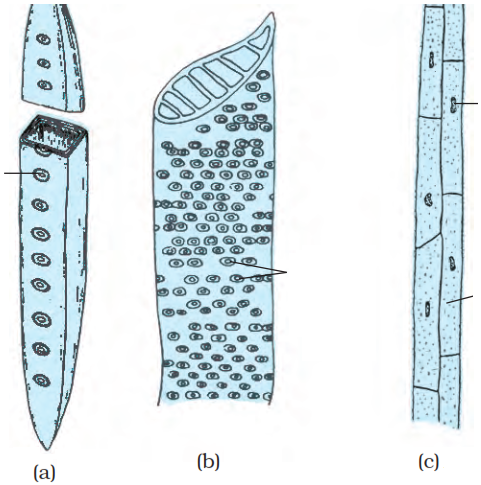
  1. Identify the structures marked below as A, B and C.
  2. Complete the labeling of each structure.
  3. Write the function of each structure.
Answer

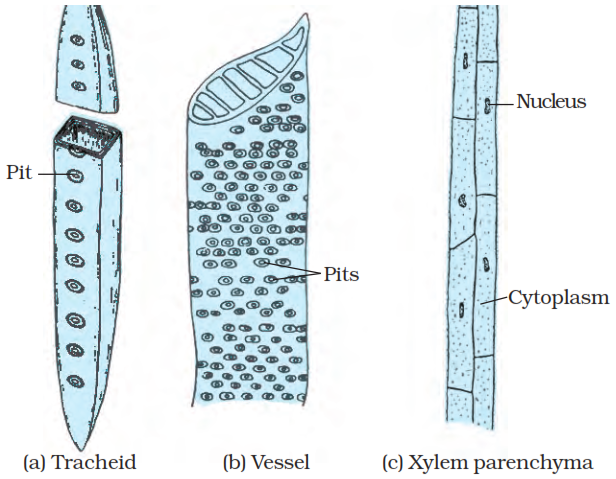
  1. A- Tracheid B- Vessel C- Xylem parenchyma.
  2.  
  1. Tracheids- It helps in transmission of water.
Vessels- It helps in transmission of minerals.
Xylem parenchyma- It stores food and helps in conduction of water.

Need a full question paper?

Generate a complete, print-ready paper with questions like this in minutes — across 16+ boards, with answer keys.

Start Generating Free

Similar questions

Define crop? Name the various types of crops. What are Kharif and Rabi crops?
Why are we able to sip hot tea or milk faster from a saucer rather than from a cup?
Show by means of graphical method that:
v = u + at
where the symbols have their usual meanings.
When extremely small particles X derived from the another of a flower were suspended in a liquid Y and observed through a microscope, it was found that the particles X were moving throughout the liquid Y in a very zig zag way. It was also observed that warmer the liquid Y, faster the particles X moved in its surface.
  1. What could particles X be?
  2. What do you think liquid Y is?
  3. What is the zig-zag movement of particles X?
  4. What is causing the zig-zag movement of particles X?
  5. Name the scientist who discovered this phenomenon.
  6. What does this experiment tell us about the nature of liquid Y?
A train travels the first 15km at a uniform speed of 30 km/h; the next 75km at a uniform speed of 50km/h; and the last 10km at a uniform speed of 20km/h.
Calculate the average speed for the entire train journey.
The mass of one molecule of a substance is $4.65 \times 10^{-23}g.$ What is its molecular mass? What could this substance be?
A body of $2\ kg$ falls from rest. What will be its kinetic energy during the fall at the end of $2s?\ ($Assume $g = 10\ m/s^2)$
Write down symptoms of sick animals. Discuss any two diseases of cattle.
Compute the difference in masses of $10^3$ moles each of magnesium atoms and magnesium ions. $($Mass of an electron $=9.1 \times 10^{-31}kg)$
Mention two ways by which a photosynthesing cell belonging to this group differs from a cell of your body.