Question
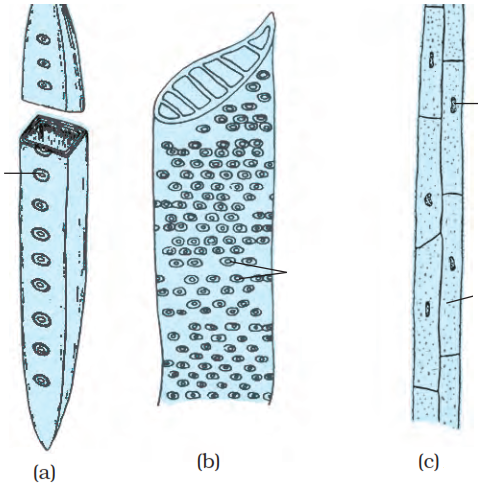
  1. Identify the structures marked below as $A, B$ and $C.$
  2. Complete the labeling of each structure.
  3. Write the function of each structure.
Answer

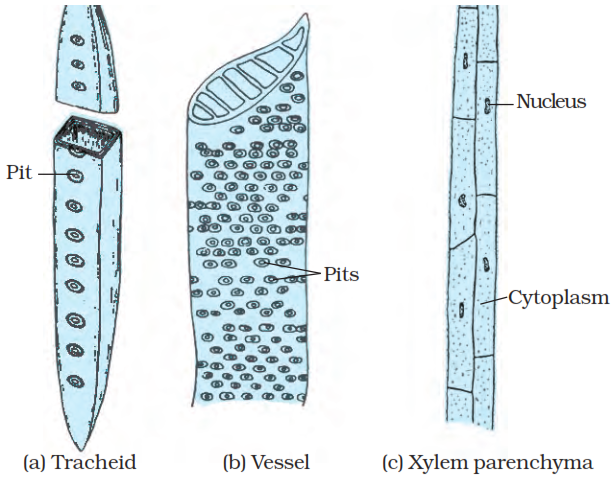
  1. A- Tracheid $B-$ Vessel $C-$ Xylem parenchyma.
  2.  
  1. Tracheids- It helps in transmission of water.
Vessels- It helps in transmission of minerals.
Xylem parenchyma- It stores food and helps in conduction of water.

Need a full question paper?

Generate a complete, print-ready paper with questions like this in minutes — across 16+ boards, with answer keys.
Start Generating Free

Similar questions

An object is dropped from rest at a height of $150m$ and simultaneously another object is dropped from rest at a height $100m$. What is the difference in their heights after $2s$ if both the objects drop with same accelerations$?$ How does the difference in heights vary with time$?$
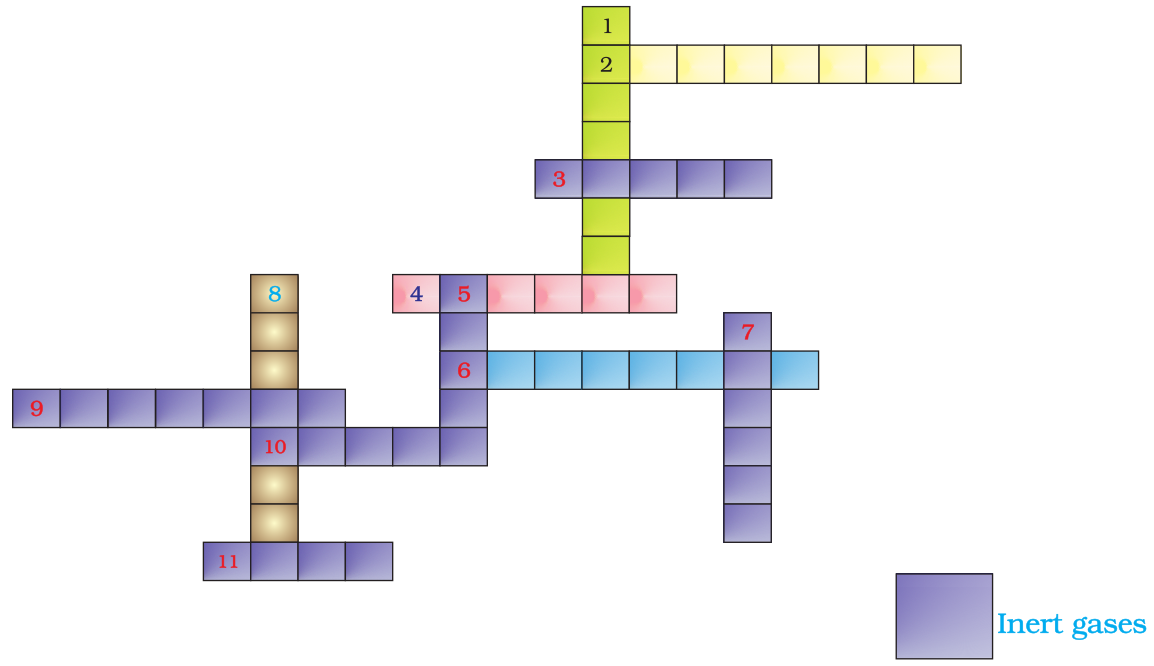
In this crossword puzzle (Figure), names of $11$ elements are hidden. Symbols of these are given below. Complete the puzzle.
  1. $Cl$
  2. $H$
  3. $Ar$
  4. $O$
  5. $Xe$
  6. $N$
  7. $He$
  8. $F$
  9. $Kr$
  10. $Rn$
  11. $Ne$
What weight of oxygen gas will contain the same number of molecules as $56g$ of nitrogen gas? $(O = 16u; N = 14u)$
How are simple tissues different from complex tissues in plants?
When extremely small particles $X$ derived from the another of a flower were suspended in a liquid $Y$ and observed through a microscope, it was found that the particles $X$ were moving throughout the liquid $Y$ in a very zig zag way. It was also observed that warmer the liquid $Y,$ faster the particles $X$ moved in its surface.
  1. What could particles $X$ be$?$
  2. What do you think liquid $Y$ is$?$
  3. What is the zig-zag movement of particles $X?$
  4. What is causing the zig-zag movement of particles $X?$
  5. Name the scientist who discovered this phenomenon.
  6. What does this experiment tell us about the nature of liquid $Y?$
What are the symptoms and causes of malaria$?$ How can it be prevented and controlled$?$
Write an essay on crop protection management.
Write the main function of each of the following.
(a) Plasma membrane
(b) cell wall
(c) Ribosome
(d) Lysosome
(e) Nucleolus
(f) Endoplasmic reticulum
How long will it take a force of $10\ N$ to stop a mass of $2.5\ kg$ which is moving at $20\ m/s?$
When a beam of sunlight enters a room through a window, we can see tiny particles $X$ suspended in a gas $($or rather a mixture of gases$) Y$ which are moving rapidly in a very haphazard manner.
  1. What could particles $X$ be$?$
  2. Name the gas $($or mixture of gases$) Y.$
  3. What is the phenomenon exhibited by particles $X$ known as$?$
  4. What is causing the movement of particles $X?$
  5. What conclusion does the existence of this phenomenon give us about the nature of matter$?$