MCQ
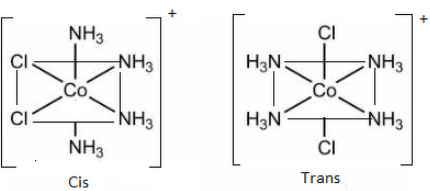
Identify the type of isomerism shown by [Co(NH3​)4​Cl2​]+:
  • A
    Geometrical cis, trans
  • B
    Geometrical fac, mer
  • C
    Optical
  • D
    None of the above

Answer

  1. Geometrical cis, trans

Explanation:

[Co(NH3​)4​Cl2​]+ will show cis, trans geometrical isomerism.
Need a full question paper?

Generate a complete, print-ready paper with questions like this in minutes — across 16+ boards, with answer keys.

Start Generating Free

Similar questions

Which one of the following on treatment with $50\%$ aqueous sodium hydroxide yields the corresponding alcohol and acid ?
Given below are two statements :

Statement $I$: Aniline reacts with con. $\mathrm{H}_2 \mathrm{SO}_4$ followed by heating at $453-473 \mathrm{~K}$ gives $\mathrm{p}$ aminobenzene sulphonic acid, which gives blood red colour in the 'Lassaigne's test'.

Statement $II$: In Friedel - Craft's alkylation and acylation reactions, aniline forms salt with the $\mathrm{AlCl}_3$ catalyst. Due to this, nitrogen of aniline aquires a positive charge and acts as deactivating group.

In the light of the above statements, choose the correct answer from the options given below :

Oxidation states of $P$ in $H_4P_2O_5,\, H_4P_2O_6,\, H_4P_2O_7$, are respectively
The relationship between osmotic pressure at $273\,K$ when $10\,g$ glucose $({P_1}),\,10\,g$ urea $({P_2})$ and $10\,g$ sucrose $({P_3})$ are dissolved in $250\,ml$ of water is
Identify the correct reagents that would bring about the following transformation.
$9.3 \mathrm{~g}$ of pure aniline upon diazotisation followed by coupling with phenol gives an orange dye. The mass of orange dye produced (assume $100$% yield/ conversion) is  . . . . . $g$. (nearest integer)
In a catalytic conversion of ${N_2}$ to $N{H_3}$ by Haber's process, the rate of reaction was expressed as change in the concentration of ammonia per time is $40 \times {10^{ - 3}}\,mol\,litr{e^{ - 1}}{s^{ - 1}}$. If there are no side reaction, the rate of the reaction as expressed in terms of hydrogen is (in mol $litr{e^{ - 1}}{s^{ - 1}}$)
Which of the following mixture is chromic acid
Which is not true for arginine?
The gas liberated by the electrolysis of Dipotassium succinate solution is