MCQ
Identify the type of material based on the T-ρ graph given below.
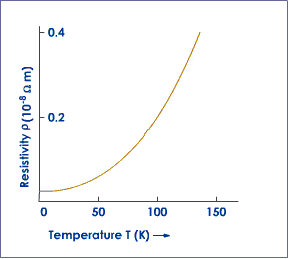
- ASilicon
- BPolymer
- CNichrome
- DCopper
Explanation:
For metals, the temperature coefficient of resistivity is positive. At lower temperatures, the resistivity of a pure metal increases as a higher power of temperature. So, the answer is copper, which is a metal.
Generate a complete, print-ready paper with questions like this in minutes — across 16+ boards, with answer keys.
A P-type semiconductor can be obtained by adding
|
(a) Arsenic to pure silicon |
(b) Gallium to pure silicon |
|
(c) Antimony to pure germanium |
(d) Phosphorous to pure germanium |
In a triode amplifier, the value of maximum gain is equal to
|
(a) Half the amplification factor |
(b) Amplification factor |
|
(c) Twice the amplification factor |
(d) Infinity |
A diffraction is obtained by using a beam of red light. What will happen if the red light is replaced by the blue light
|
(a) Bands will narrower and crowd full together |
|
(b) Bands become broader and further apart |
|
(c) No change will take place |
|
(d) Bands disappear |
A metal surface of work function 1.07 eV is irradiated with light of wavelength 332 nm. The retarding potential required to stop the escape of photo-electrons is
|
(a) 4.81 eV |
(b) 3.74 eV |
(c) 2.66 eV |
(d) 1.07 eV |
A transformer is employed to reduce 220 V to 11 V. The primary draws a current of 5 A and the secondary 90 A. The efficiency of the transformer is
|
(a) 20% |
(b) 40% |
(c) 70% |
(d) 90% |
$\text{y}=(0.001\text{mm})\sin\Big[(50\text{s}^{-1})\text{t}+(2.0\text{m}^{-1})\text{x}\Big]$