MCQ
Identify the which can exhibit tautomerism ?
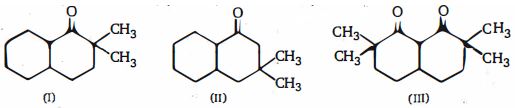
  • A
    $I$ only
  • B
    $II$ only
  • C
    $III$ only
  • D
    all of these

Answer

$(d)\, \alpha -$ hydrogen attached to $sp^3$ carbon is present in all structures.

Need a full question paper?

Generate a complete, print-ready paper with questions like this in minutes — across 16+ boards, with answer keys.

Start Generating Free

Similar questions

An organic compound $P$ having molecular formula $C _6 H _6 O _3$ gives ferric chloride test and does not have intramolecular hydrogen bond. The compound $P$ reacts with $3$ equivalents of $NH _2 OH$ to produce oxime $Q$. Treatment of $P$ with excess methyl iodide in the presence of $KOH$ produces compound $R$ as the major product. Reaction of $R$ with excess iso-butylmagnesium bromide followed by treatment with $H _3 O ^{+}$gives compound $S$ as the major product.

The total number of methyl $\left(- CH _3\right)$ group($s$) in compound $S$ is. . . . 

In which of the following reaction $H_2O_2$ acts as reducing agent 
$(I)$ $H_2O_2 + 2H^+ + 2e^-\to 2H_2O$
$(II)$ $H_2O_2 + 2e^-\to O_2 + 2H^+$
$(III)$ $H_2O_2 + 2e^-\to 2 OH^-$
$(IV)$ $H_2O_2 + 2OH^-+ 2e^-\to O_2 + 2H_2O$
The reaction $A\xrightarrow{k}$ Producl, is zero order while the reaction $B\xrightarrow{k}$ Product, is first order reaction. For what initial concentration of $A$ are the half lives of two reactions equal ?
Which of the following orbitals represents $3d_{z^2}$ orbitals ?
In $C{H_3}C{H_2}OH,$ the bond that undergoes heterolytic cleavage most readily is
In which orbit of the Bohr model of the hydrogen atom is the speed of electron maximum
$2\, mole$ of $N_2H_4$ loses $16\, mole$ of electron is being converted to a new compound $X$. Assuming that all of the $N$ appears in the new compound. What is the oxidation state of $'N'$ in $X$ ?
The equilibrium constant $K_p$ for the following reaction at $191\,^oC$ is $1.24$. What is the value of $K_c$ ? $B\left( s \right) + \frac{3}{2}{F_2}_{\left( g \right)} \rightleftharpoons B{F_3}_{\left( g \right)}$
Among the following, the state function(s) is$(are)$

$(A)$ Internal energy $(B)$ Irreversible expansion work

$(C)$ Reversible expansion work $(D)$ Molar enthalpy

Which of the following halogen can be purified by sublimation