MCQ
Identify the wrong description of the above figures
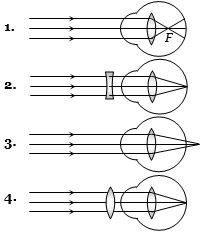
  • $1$ represents far-sightedness
  • B
    $2$ correction for short sightedness
  • C
    $3$ represents far sightedness
  • D
    $4$ correction for far-sightedness

Answer

Correct option: A.
$1$ represents far-sightedness
a
(a) In figure $1,$ parallel rays, that is, rays coming from infinity converge and focus before reaching the retina, hence the person is not able to see far objects, and is nearsighted.

Need a full question paper?

Generate a complete, print-ready paper with questions like this in minutes — across 16+ boards, with answer keys.
Start Generating Free

Similar questions

One circular ring and one ciruclar disc, both are having the same mass and radius. the ratio of their moments of inertia about the axes passing through their centres and perpendicular to their planes, will be
A body falls freely under gravity. Its speed is $v$ when it has lost an amount $U$ of the gravitational energy. Then its mass is
To what temperature should the hydrogen at $327°C$ be cooled at constant pressure, so that the root mean square velocity of its molecules become half of its previous value ....... $^oC$
If a particle is executing simple harmonic motion, then acceleration of particle
A current $i$ $ampere$ flows along an infinitely long straight thin walled tube, then the magnetic induction at any point inside the tube is
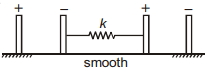
Two charged capacitors have their outer plates fixed and inner plates connected by a spring of force constant ' $k$ '. The charge on each capacitor is q. Find the extension in the spring at equilibrium
A rod $(AB)$ is attached to a fixed point $(C)$ using a light rope $(AC)$. The other end of the rod $(B)$ is sitting on ice with negligible friction and the system is in stationary position. Which of the following can be the equilibrium configuration of this system?
A billiard ball moving with a speed of $5 \,m/s$ collides with an identical ball originally at rest. If the first ball stops after collision, then the second ball will move forward with a speed of ...........  $m{s^{ - 1}}$
A ball is dropped vertically downwards from a height $h$ above the ground. It hits the ground inelastically and bounces up vertically. Neglecting subsequent motion and air resistance, which of the following graph represents variation between speed $(v)$ and height $(h)$ correctly?
In photoelectric effect, the electrons are ejected from metals if the incident light has a certain minimum