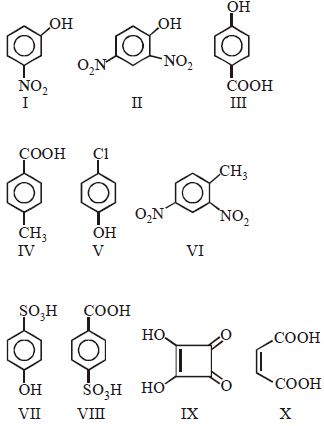
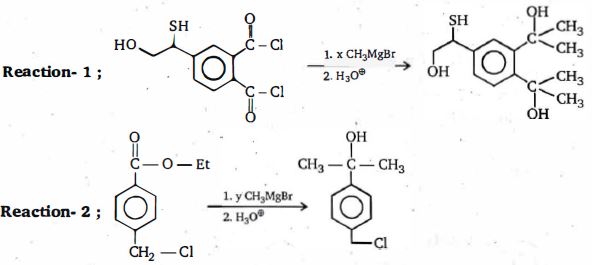
Question
Identify the wrong statement in the following
Generate a complete, print-ready paper with questions like this in minutes — across 16+ boards, with answer keys.
| List-I (Complexes) | List-II (Types) |
| (a) $\left[ Co \left( NH _3\right)_5 CN \right] Cl _2$ | (i) ionisation isomerism |
| (b) $\left[ Cr \left( NH _3\right)_6\right]\left[ Co ( CN )_6\right]$ | (ii) coordination isomerism |
| (c) $\left[ Co \left( NH _3\right)_5\left( SO _4\right)\right] Br$ | (iii) linkage isomerism |
| column $(I)$ | column $(II)$ | ||
| $(A)$ | Kohlraush law | $(i)$ | $\Lambda _{eq}^o = \Lambda _c^o + \Lambda _a^o$ |
| $(B)$ | Molar Conductivity |
$(ii)$ | $\Lambda _m = \frac{{K \times 1000}}{M}$ |
| $(C)$ | Degree of Dissociation |
$(iii)$ | $\alpha = {\Lambda _m}/\Lambda _m^o$ |
| $(D)$ | Dissociation Constant |
$(iv)$ | ${k_a} = C{\alpha ^2}/1 - \alpha $ |
$2 \mathrm{Fe}_{(\mathrm{s})}+\frac{3}{2} \mathrm{O}_{2(\mathrm{~g})} \rightarrow \mathrm{Fe}_2 \mathrm{O}_{3(\mathrm{~s})}, \Delta \mathrm{H}^{\mathrm{o}}=-822 \mathrm{~kJ} / \mathrm{mol}$
$\mathrm{C}_{(\mathrm{s})}+\frac{1}{2} \mathrm{O}_{2(\mathrm{~g})} \rightarrow \mathrm{CO}_{(\mathrm{g})}, \Delta \mathrm{H}^{\mathrm{o}}=-110 \mathrm{~kJ} / \mathrm{mol}$
Then enthalpy change for following reaction
$3\mathrm{C}_{(\mathrm{s})}+\mathrm{Fe}_2 \mathrm{O}_{3(\mathrm{~s})} \rightarrow 2 \mathrm{Fe}_{(\mathrm{s})}+3 \mathrm{CO}_{(\mathrm{g})}$