Question
Identify which of the following color light, when passed through a double-slit opening, will produce the widest central band of light on the screen?

Answer

  1. Red
Explanation:
Fringe width $\beta= \frac{\lambda\text{D}}{\text{d}}$ where λ is the wavelength of the light used
$\Rightarrow\beta\propto\lambda$
As wavelength of the red light is the largest among the visible light, thus fringe width is the greatest formed due to red light.

Need a full question paper?

Generate a complete, print-ready paper with questions like this in minutes — across 16+ boards, with answer keys.
Start Generating Free

Similar questions

The lowest resistance which can be obtained by connecting 10 resistors each of 1/10 ohm is(a) 1/250 Ω(b) 1/200 Ω(c) 1/100 Ω(d) 1/10 Ω
       
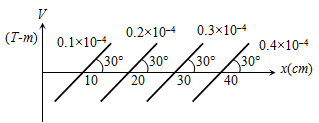
Some equipotential surfaces of the magnetic scalar potential are shown in the figure. Magnetic field at a point in the region is
is equal to the work done by an external agent in carrying a unit of positive charge from the arbitrarily chosen reference point (usually infinity) to that point without any acceleration.
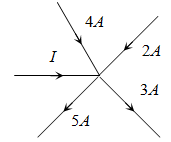
In the given current distribution what is the value of $I$
Electrical conductivity of a semiconductor(a) Decreases with the rise in its temperature (b) Increases with the rise in its temperature (c) Does not change with the rise in its temperature(d) First increases and then decreases with the rise in its temperature


Albedo is maximum for(a) Pluto(b) Venus(c) Earth(d) Mercury
       
Heat radiations propagate with the speed of(a) a-rays(b) b-rays(c) Light waves(d) Sound waves
       
Magnetic moments of two bar magnets may be compared with the help of(a)  Deflection magnetometer(b) Vibration magnetometer(c) Both of the above(d) None of the above
   
   
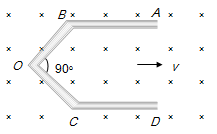
A conductor $\ce{ABOCD}$ moves along its bisector with a velocity of $1 \mathrm{~m} / \mathrm{s}$ through a perpendicular magnetic field of $1 \ \mathrm{wb} / \mathrm{m}^2$, as shown in fig. If all the four sides are of $1 m$ length each, then the induced emf between points $A$ and $D$ is 
The state of photo-electrons emerging from the metal surface can be :