MCQ
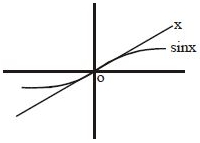
If $0 < x < \frac{\pi }{2},$ then
  • A
    $\frac{2}{\pi } > \frac{{\sin \,x}}{x}$
  • $\frac{{\sin \,x}}{x} < 1$
  • C
    $\frac{{\sin \,x}}{x} < 0.5$
  • D
    $\frac{{\sin \,x}}{x} > 1$

Answer

Correct option: B.
$\frac{{\sin \,x}}{x} < 1$
b
For $x>0$

$x>\sin x$

$\frac{\sin x}{x}<1$

Need a full question paper?

Generate a complete, print-ready paper with questions like this in minutes — across 16+ boards, with answer keys.

Start Generating Free

Similar questions

If $\int \frac{\cos x-\sin x}{\sqrt{8-\sin 2 x}} d x=a \sin ^{-1}\left(\frac{\sin x+\cos x}{b}\right)+c$ where $c$ is a constant of integration, then the ordered pair $( a , b )$ is equal to
Let $a, b \in R$. Let the mean and the variance of $6$ observations $-3,4,7,-6$, $a,\ b$ be $2$ and $23$ , respectively. The mean deviation about the mean of these $6$ observations is :
Three persons $P, Q$ and $R$ independently try to hit a target . If the probabilities of their hitting the target are $\frac{3}{4},\frac{1}{2}$ and $\frac{5}{8}$ respectively, then the probability that the target is hit by $P$ or $Q$ but not by $R$ is
If $\int_{ - 1}^4 {f(x)\,dx} = 4$ and $\int_2^4 {(3 - f(x))\,dx = 7,} $ then the value of $\int_2^{ - 1} {f(x)\,dx} $ is
Let a vector $\vec{a}$ has a magnitude $9$ . Let a vector $\vec{b}$ be such that for every $(x, y) \in R \times R-\{(0,0)\}$, the vector $(x \vec{a}+y \vec{b})$ is perpendicular to the vector (6y $\vec{a}-18 \times \vec{b}$ ). Then the value of $|\vec{a} \times \vec{b}|$ is equal to.
Let $f : R \rightarrow R$ be a continuous odd function, which vanishes exactly at one point and $f(1)=\frac{1}{2}$. Suppose that $F(x)=\int_{-1}^x f(t) d t$ for all $x \in[-1,2]$ and $G(x)=\int_{-1}^x t|f(f(t))| d t$ for all $x \in[-1,2]$. If $\lim _{x \rightarrow 1} \frac{F(x)}{G(x)}=\frac{1}{14}$, then the value of $f\left(\frac{1}{2}\right)$ is
The differential coefficient of $f[\log (x)]$ when $f(x) = \log x$ is
The number of solutions of equation $3cos^2x - 8sinx = 0$ in $[0, 3\pi]$ is
$\int_{}^{} {\frac{{{e^{5\log x}} - {e^{4\log x}}}}{{{e^{3\log x}} - {e^{2\log x}}}}\;dx = } $
If $\alpha $ and $\beta $ are the roots of the equation ${x^2} - a(x + 1) - b = 0$ then $(\alpha + 1)(\beta + 1) = $