MCQ
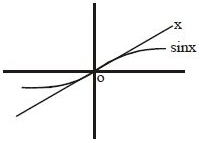
If $0 < x < \frac{\pi }{2},$ then
  • A
    $\frac{2}{\pi } > \frac{{\sin \,x}}{x}$
  • $\frac{{\sin \,x}}{x} < 1$
  • C
    $\frac{{\sin \,x}}{x} < 0.5$
  • D
    $\frac{{\sin \,x}}{x} > 1$

Answer

Correct option: B.
$\frac{{\sin \,x}}{x} < 1$
b
For $x>0$

$x>\sin x$

$\frac{\sin x}{x}<1$

Need a full question paper?

Generate a complete, print-ready paper with questions like this in minutes — across 16+ boards, with answer keys.

Start Generating Free

Similar questions

If a > 0 and discriminant of ax2 + 2bx + c is negative, then $\triangle=\begin{vmatrix}\text{a}&\text{b}&\text{ax}+\text{b}\\\text{b}&\text{c}&\text{bx}+\text{c}\\\text{ax}+\text{b}&\text{bx}+\text{c}&0\end{vmatrix}$ is:
  1. Positive
  2. (ac - b2)(ax2 + 2bx + c)
  3. Negative
  4. 0
The maximum number of equivalence relations on the set A = {1, 2, 3} are:
  1. 1
  2. 2
  3. 3
  4. 5
If a line makes angles $\frac{\pi}{2}, \frac{3 \pi}{4}$ and $\frac{\pi}{4}$ with $X, Y$, and $Z$-axes respectively, then its direction cosines are
The projections of a line segment on x, y and z axes are 12, 4 and 3 respectively. The length and direction cosines of the line segment are:

  1. $13;\frac{12}{13},\frac{4}{13},\frac{3}{13}$

  2. $19;\frac{12}{19},\frac{4}{19},\frac{3}{19}$

  3. $11;\frac{12}{11},\frac{14}{11},\frac{3}{11}$

  4. $\text{None of these}$

Let $f(x)$ = $\int\limits_0^x {({t^2} + 2t + 2)dt} $ where $x$ is set of real numbers satisfying the inequation ${\log _{\sqrt 2 }}(1 + \sqrt {6x - {x^2} - 8} ) \ge 0$ If range of $f(x)$ is $[a, b]$ then $(a + b)$ is
Let $(\alpha, \beta, \gamma)$ be the foot of perpendicular from the point $(1,2,3)$ on the line $\frac{x+3}{5}=\frac{y-1}{2}=\frac{z+4}{3}$. then $19(\alpha+\beta+\gamma)$ is equal to :
If $\text{A}=\begin{bmatrix}a^2 &\text{amp; ab}&\text{amp; ac} \\\text{ab}&\text{amp; }\text{b}^2&\text{amp;}\text{ bc}\\\text{ac}&\text{amp;}\text{bc}&\text{amp;}\text{c}^2 \end{bmatrix}$and $\text{a}^2+\text{b}^2+\text{c}^3=1$ then $\text{A}^2=$
  1. $2\text{A}$
  2. $\text{A}$
  3. $3\text{A}$
  4. $\frac{1}{2}\text{A}$
The direction cosines of the normal to the plane $x + 2y - 3z + 4 = 0$ are
Let $A=\left(\begin{array}{cc}1+ i & 1 \\ - i & 0\end{array}\right)$ where $i =\sqrt{-1}$ Then, the number of elements in the set $\left\{ n \in\{1,2, \ldots, 100\}: A ^{ n }= A \right\}$ is
$\int_{\pi /6}^{\pi /4} {{\rm{cosec}}\,2x\,dx = } $