MCQ
If $10^\text{n} + 3 \times 4^{\text{n}+2}+\lambda$ is divisible by 9 for all $\text{n}\in\text{N},$ then the least positive integer value of $\lambda$ is
  • 5
  • B
    3
  • C
    7
  • D
    1

Answer

Correct option: A.
5
Given,
$10\text{n }+3\times^{\text{n}+2}+\lambda$ is divisible by 9,
$\text{P}(1)=10^1+3\times4^{1+2}+\lambda$ is exactly divisible by 9 then the value of $\lambda$ is 5.

Need a full question paper?

Generate a complete, print-ready paper with questions like this in minutes — across 16+ boards, with answer keys.
Start Generating Free

Similar questions

The middle term in the expansion of $\Big(\frac{2\text{x}}{3}=\frac{3}{2\text{x}^{2}}\Big)^{2\text{n}}$ is:
If $^n{C_{r - 2}} = 36$ , $^n{C_{r - 1}} = 84$   and    $^n{C_r} = 126$ , then value of $^n{C_{2r}}$ is
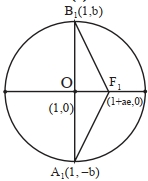
Let an ellipse with centre $(1,0)$ and latus rectum of length $\frac{1}{2}$ have its major axis along $x$-axis. If its minor axis subtends an angle $60^{\circ}$ at the foci, then the square of the sum of the lengths of its minor and major axes is equal to $...........$.
A card is drawn from a pack of cards. Find the probability that the card will be a queen or a heart
Let $\left(x_0, y_0\right)$ be the solution of the following equations $(2 x)^{\ln 2} =(3 y)^{\ln 3}$ $3^{\ln x} =2^{\ln y}$ . Then $x_0$ is
If two distinct chords, drawn from the point $(p, q)$ on the circle ${x^2} + {y^2} = px + qy$, (where $pq \ne 0$) are bisected by the $x$ - axis, then
There are $5$ roads leading to a town from a village. The number of different ways in which a villager can go to the town and return back, is
The following data gives the distribution of height of studentsThe median of the distribution is

Height (in cm)

160

150

152

161

156

154

155

No of students

12

8

4

4

3

3

7

If two events $A$ and $B$ are such that $P\,(A + B) = \frac{5}{6},$ $P\,(AB) = \frac{1}{3}\,$ and $P\,(\bar A) = \frac{1}{2},$ then the events $A$ and $B$ are
Let $a_{n}$ be the $n^{\text {th }}$ term of a G.P. of positive terms.

If $\sum\limits_{n=1}^{100} a_{2 n+1}=200$ and $\sum\limits_{n=1}^{100} a_{2 n}=100,$ then $\sum\limits_{n=1}^{200} a_{n}$ is equal to