MCQ
If $1+\left(1-2^{2} \cdot 1\right)+\left(1-4^{2} \cdot 3\right)+\left(1-6^{2} \cdot 5\right)+\ldots \ldots+\left(1-20^{2} \cdot 19\right)$ $=\alpha-220 \beta,$ then an ordered pair $(\alpha, \beta)$ is equal to 
  • A
    $(10,97)$
  • $(11,103)$
  • C
    $(10,103)$
  • D
    $(11,97)$

Answer

Correct option: B.
$(11,103)$
b
$1+\left(1-2^{2} \cdot 1\right)+\left(1-4^{2} \cdot 3\right)+\ldots \ldots+\left(1-20^{2} \cdot 19\right)$

$=\alpha-220 \beta$

$=11-\left(2^{2} \cdot 1+4^{2} \cdot 3+\ldots \ldots+20^{2} \cdot 19\right)$

$=11-2^{2} \cdot \sum_{ r =1}^{10} r ^{2}(2 r -1)=11-4\left(\frac{110^{2}}{2}-35 \times 11\right)$

$=11-220(103)$

$\Rightarrow \alpha=11, \beta=103$

Need a full question paper?

Generate a complete, print-ready paper with questions like this in minutes — across 16+ boards, with answer keys.

Start Generating Free

Similar questions

If $\sin ^2 \theta=3 \cos ^2 \theta$, then the value of $\theta$ is :
Let $X =\left({ }^{10} C _1\right)^2+2\left({ }^{10} C _2\right)^2+3\left({ }^{10} C _3\right)^2+\ldots \ldots . .+10\left({ }^{10} C _{10}\right)^2$ where ${ }^{10} C _{ r }, r \in\{1,2, \ldots ., 10\}$ denote binomial coefficients. Then, the value of $\frac{1}{1430} X$ is. . . . . . .
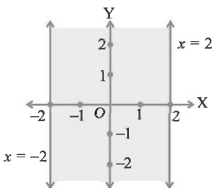
The inequality representing the coloured region in figure is $\ldots \ldots . .$
The first three of four given numbers are in $G.P.$ and their last three are $A.P.$ with common difference $6$. If first and fourth numbers are equal, then the first number is:
If $a^3 + b^6 = 2$, then the maximum value of the term independent of $x$ in the expansion of  $(ax^{\frac{1}{3}}+bx^{\frac{-1}{6}})^9$ is, where $(a > 0, b > 0)$
A straight line passes through a fixed point $(h,k)$. The locus of the foot of perpendicular on it drawn from the origin is
Let $\alpha=\frac{-1+i \sqrt{3}}{2} .$ If $a=(1+\alpha) \sum\limits_{k=0}^{100} \alpha^{2 k}$ and $\mathrm{b}=\sum\limits_{\mathrm{k}=0}^{100} \alpha^{3 \mathrm{k}},$ then a and $\mathrm{b}$ are the roots of the quadratic equation
If $A + B + C = \pi ,$ then $\cos \,\,2A + \cos \,\,2B + \cos \,\,2C = $
Sum of the solutions of the equation $\left[ {{x^2}} \right] - 2x + 1 = 0$ is (where $[.]$ denotes greatest integer function)
Let $a \neq b$ be two non-zero real numbers.Then the number of elements in the set $X =\left\{ z \in C : \operatorname{Re}\left(a z^2+ bz \right)= a \text { and }\operatorname{Re}\left(b z^2+ az \right)= b \right\}$ is equal to