Question
If $1+\sqrt{2}$ is a root of a quadratic equation will rational coefficients, write its other root.

Answer

Given that $(1+\sqrt{2})$ is a root of the quadratic equation with rational coefficients.
Then find the other root.
As we know that if $(1+\sqrt{2})$ is a root of the quadratic equation with rational.
coefficients then other roots be $(1+\sqrt{2})$
Hence, the require root of the quadratic equation be $(1+\sqrt{2})$

Need a full question paper?

Generate a complete, print-ready paper with questions like this in minutes — across 16+ boards, with answer keys.
Start Generating Free

Similar questions

Find the value of k for which the following systems of equations has unique solution:
$4x + ky + 8 = 0, x + y + 1 = 0$
If $\alpha$ and $\beta$ are the zeroes of the quadratic polynomial $f(x) = x^2 - x - 2$, find the value of $\frac{1}{\alpha}-\frac{1}{\beta}$
If two vertices of a parallelogram are $(3,2)(-1,0)$ and the diagonals cut at $(2,-5)$, find the other vertices of the parallelogram.
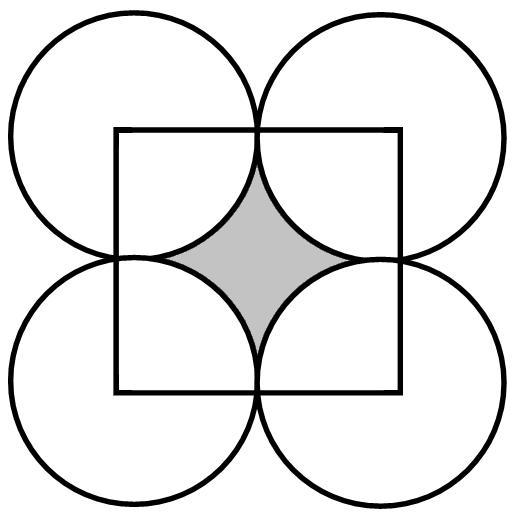
The diameter of a coin is $1\ cm$ (in the following figure). If four such coins be placed on a table so that the rim of each touches that of the other two, find the area of the shaded region $\big(\text{Take }\pi = 3.1416\big). $
Find the value of k for which the following systems of equations has no solution:
3x - y - 5 = 0,
6x - 2y + k = 0 $(\text{k}\neq0).$
The marks obtained out of $50$, by $102$ students in a Physics test are given in the frequency table below:
Marks (x)
$15$
$20$
$22$
$24$
$25$
$30$
$33$
$38$
$45$
Frequncy (f)
$5$
$8$
$11$
$20$
$23$
$18$
$13$
$3$
$1$
Find the average number of marks.
If $\alpha$ and $\beta$ are the zeros of the quadratic polynomial $f ( t )= t ^2-4 t +3$, find the value of $\alpha^4 \beta^3+\alpha^3 \beta^4$.
Find the sum of the first $15$ multiples of$ 8.$
For what value of k does the system of equations:
$kx + 2y = 5, 3x - 4y = 10$
have;
  1. A unique solution,
  2. No solution?
Rain water, which falls on a flat rectangular surface of length $6\ m$ and breadth $4\ m$ is transferred into a cylindrical vessel of internal radius $20\ cm$. What will be the height of water in the cylindrical vessel if a rainfall of 1cm has fallen?