Question
If $3^{\text{x}+1}=9^{\text{x}-2},$ find the value of $2^{1+\text{x}}.$

Answer

$3^{\text{x}+1}=9^{\text{x}-2}$
$\Rightarrow3​^\text{x}\times3=9^\text{x}\times9^{-2}$
$\Rightarrow3^\text{x}\times3=(3^2)^\text{x}\times\frac{1}{9^2}$
$\Rightarrow3^\text{x}\times3=3^{2\text{x}}\times\frac{1}{(3^2)^2}$
$\Rightarrow3^\text{x}\times3\times3^{2\text{x}}\times\frac{1}{3^4}$
$\Rightarrow\frac{3^{2\text{x}}}{3^\text{x}}=3\times3^4$
$\Rightarrow3^{2\text{x}-\text{x}}=3^5$
$\Rightarrow3^\text{x}=3^5$
$\Rightarrow\text{x}=5$
$\Rightarrow2^{1+\text{x}}=2^{1+5}=2^6=64$

Need a full question paper?

Generate a complete, print-ready paper with questions like this in minutes — across 16+ boards, with answer keys.
Start Generating Free

Similar questions

(Street Plan): A city has two main roads which cross each other at the centre of the city. These two roads are along the North-South direction and East-West direction. All the other streets of the city run parallel to these roads and are $200 \ m$ apart. There are $5$ streets in each direction. Using $1\ cm = 200 \ m$, draw a model of the city on your notebook. Represent the roads/streets by single lines. There are many cross- streets in your model. A particular cross-street is made by two streets, one running in the North-South direction and another in the East-West direction. Cross street is referred to in this manner: If the 2nd street running in the North-South direction and 5th in the East-West direction meet at some crossing, then we will call this cross-street $(2, 5)$. Using this convention, find: how many cross - streets can be referred to as $(3, 4).$
Factorize the following expressions:
$125+8 x^3-27 y^3+90 x y$
A cube of side $4\ cm$ contains a sphere touching its side. Find the volume of the gap in between.
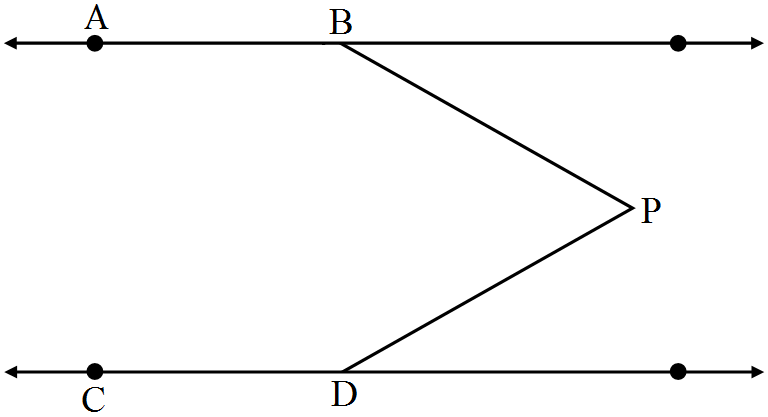
In figure, $AB\ ||\ CD$ and $P$ is any point shown in the figure. Prove that: $\angle\text{ABP}+\angle\text{BPD}+\angle\text{CDP}=360^\circ$
From a point in the interior of an equilateral triangle, perpendiculars are drawn on the three sides. The lengths of the perpendiculars are $14 \ cm, 10 \ cm$ and $6 \ cm.$ Find the area of the triangle.
If $a-b=6$ and $a b=20$, find the value of $a^3-b^3$.
Explain how irrational number is differ from rational numbers?
Find the value to three place of decimals of each of the following. It is given that $\sqrt2=1.414,\ \sqrt3=1.732,\ \sqrt5=2.236,\ \sqrt10=3.162.$
$\frac{\sqrt{10}+\sqrt{15}}{\sqrt{2}}$
Diagonals $A C$ and $B D$ of a parallelogram $A B C D$ intersect each other at $O$. If $O A=3 cm$ and $O D=2 cm$, determine the lengths of $A C$ and $B D$.
Find six rational numbers between $2$ and $3$.